MCQ
body moves with constant angular velocity on a circle. Magnitude of angular acceleration
  • A
    $r\omega^2$
  • B
    Constant
  • Zero
  • D
    None of the above

Answer

Correct option: C.
Zero
c
(c) $\alpha = \frac{{d\omega }}{{dt}} = 0$ (As $\omega$ = constant)

Need a full question paper?

Generate a complete, print-ready paper with questions like this in minutes — across 16+ boards, with answer keys.

Start Generating Free

Similar questions

The $r.m.s.$ speed of the molecules of a gas at a pressure ${10^5}$ $Pa$ and temperature $0^\circ C$ is $0.5km\;{\sec ^{ - 1}}.$ If the pressure is kept constant but temperature is raised to $819°C,$ the velocity will become ........ $km\,sec^{-1}$
If $x = at + b{t^2}$, where $x$ is the distance travelled by the body in kilometres while $t$ is the time in seconds, then the units of $b$ are
Two planets $A$ and $B$ have the same material density. If the radius of $A$ is twice that of $B,$ then the ratio of the escape velocity $\frac{V_A}{V_B}$ is
A tank of height $5\, m$ is full of water. There is a hole of cross sectional area $1\, cm^2$ in its bottom. The initial volume of water that will come out from this hole per second is
Which types of vibration generated in gitar's wire:
Young’s modulus of steel is 1.9 × 10¹¹ N/m2. When expressed in CGS units of dynes/cm2, it will be equal to (1N = 105 dyne, 1m2 = 104cm2).
A bullet is fired from a gun. The force on the bullet is given by:

$F =  600 - 2 \times 10^5\ t$

Where $F$ is in newton and $t$ in second. The force on the bullet becomes zero as soon as it leaves the barrel. What is the average impulse imparted to the bullet?
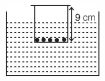
A wide bottom cylindrical massless plastic container of height $9 \,cm$ has $40$ identical coins inside it and is floating on water with $3 \,cm$ inside the water. If we start putting more of such coins on its lid, it is observed that after $N$ coins are put, its equilibrium changes from stable to unstable. Equilibrium in floating is stable if the geometric centre of the submerged portion is above the centre of the mass of the object). The value of $N$ is closed to
A body starts with an initial velocity of $10\,ms ^{-1}$ and is moving along a straight line with constant acceleration. When the velocity of the particle is $50\,ms ^{-1}$, the acceleration is reversed in direction. The velocity of the particle when it again reaches the starting point is $............\,m/s^{-1}$
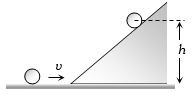
A disc of mass $M$ and radius $R$ rolls in a horizontal surface and then rolls up an inclined plane as shown in the fig. If the velocity of the disc is $v$, the height to which the disc will rise will be..