MCQ
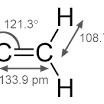
Bond length between carbon-carbon in ethylene molecule is......$ \mathop A\limits^o $
- A$1.54$
- ✓$1.35$
- C$1.19$
- D$2.4$
Generate a complete, print-ready paper with questions like this in minutes — across 16+ boards, with answer keys.
(Given, $\frac{ d (\ln K )}{ d \left(\frac{1}{T}\right)}=-\frac{\Delta H^{\ominus}}{ R }$, where the equilibrium constant, $K =\frac{ p _{ z }}{ p ^{\ominus}}$ and the gas constant, $R =8.314$ $\left.J K ^{-1} mol ^{-1}\right)$
($1$) The value of standard enthalpy, $\Delta H ^{\ominus}$ (in $kJ mol ^{-1}$ ) for the reaction is. . . . . . .
($2$) The value of $\Delta S^{\ominus}$ (in $J K ^{-1} mol ^{-1}$ ) for the given reaction, at $1000 K$ is. . . . . .
Give the answer or quetin ($1$) and ($2$)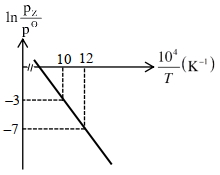
$\mathrm{MnO}_2+\mathrm{KOH}+\mathrm{O}_2 \rightarrow \mathrm{A}+\mathrm{H}_2 \mathrm{O} .$
Product ' $A$ ' in neutral or acidic medium disproportionate to give products ' $\mathrm{B}$ ' and ' $\mathrm{C}$ ' along with water. The sum of spin-only magnetic moment values of $B$ and $C$ is . . . . . .$BM$. (nearest integer)
(Given atomic number of $\mathrm{Mn}$ is $25$ )
