MCQ
Boolean expression for NAND gate is :
  • A
    $ A + B = Y $
  • B
    $ \overline{A + B} = Y $
  • $ \overline{A \cdot B} = Y $
  • D
    $ A \cdot B = Y $

Answer

Correct option: C.
$ \overline{A \cdot B} = Y $
C

Need a full question paper?

Generate a complete, print-ready paper with questions like this in minutes — across 16+ boards, with answer keys.

Start Generating Free

Similar questions

Equal potentials are applied on an iron and copper wire of same length. In order to have the same current flow in the two wires, the ratio $r\ ($iron$)\ / r\ ($copper$)$ of their radii must be $($Given that specific resistance of iron $=1.0 \times 10^{-7}$ ohm$-m$ and specific resistance of copper $=1.7 \times 10^{-8}$ ohm$-m)$
A particle of charge $-16 \times 10^{-18}$ coulomb moving with velocity $10\ ms^{-1}$ along the $x-$axis enters a region where a magnetic field of induction $B$ is along the $y-$axis, and an electric field of magnitude $10^4\ V/m$ is along the negative $z-$axis. If the charged particle continues moving along the $x-$axis, the magnitude of $B$ is
What do you understand by the static or frictional electricity?
How will you relate velocity of cathode rays to c, if ‘c' denotes the velocity of light?
How is the electric field between the two plates of a parallel plate capacitor?
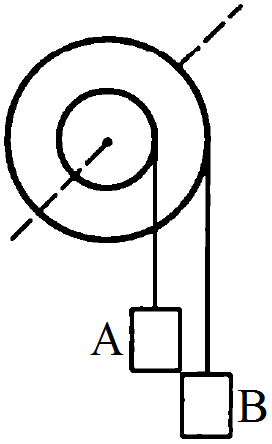
Figure shows a small wheel fixed coaxially on a bigger one of double the radius. The system rotates about the common axis. The strings supporting A and B do not slip on the wheels. If x and y be the distance travelled by A and B in the same time interval, then:
  1. x = 2y
  2. x = y
  3. y = 2x
  4. None of these.
The de$-$Broglie wavelength $\lambda$ associated with an electron having kinetic energy $E$ is given by the expression
In a copper voltameter experiment, current is decreased to one$-$fourth of the initial value but it is passed for four times the earlier duration. Amount of copper deposited will be
When the electrical conductivity  of a semi-  conductor  is due to the breaking of its covalent bonds, then the semiconductor is said to be (a) Donar   (b) Acceptor(c) Intrinsic(d) Extrinsic
       
A large cylindrical tank has a hole of area A at its bottom. Water is poured in the tank by a tube of equal cross-sectional area A ejecting water at the speed v.
  1. The water level in the tank will keep on rising.
  2. No water can be stored in the tank.
  3. The water level will rise to a height $\frac{\text{v}^2}{2\text{g}}$ and then stop.
  4. The water level will oscillate.