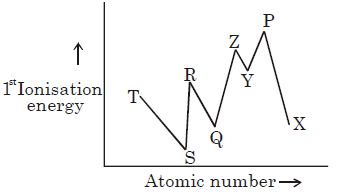
MCQ
Boric acid is acid because its molecule:
- AContamp replaceable $H^+$.
- BGives up proton.
- ✓Accepts $\ce{OH^-}$ from water and releases proton.
- DCombines with proton from water molecule.
Generate a complete, print-ready paper with questions like this in minutes — across 16+ boards, with answer keys.
$(A)$ It behaves as a weak acid in water due to self ionization.
$(B)$ Acidity of its aqueous solution increases upon addition of ethylene glycol.
$(C)$ It has a three dimensional structure due to hydrogen bonding.
$(D)$ It is weak electrolyte in water.
Reason : Size of fluorine is small and its lone pair of electrons interacts with $d-$ orbitals of $Si$ strongly.
$(A)$ Uncertainty principle rules out the existence of definite paths for electrons.
$(B)$ The energy of an electron in $2 s$ orbital of an atom is lower than the energy of an electron that is infinitely far away from the nucleus.
$(C)$ According to Bohr's model, the most negative energy value for an electron is given by $n=1$, which corresponds to the most stable orbit.
$(D)$ According to Bohr's model, the magnitude of velocity of electrons increases with increase in values of $n$.