MCQ
Boron form covalent compound due to
  • A
    Higher ionization energy
  • B
    Lower ionization energy
  • C
    Small size
  • Both $(a)$ and $(c)$

Answer

Correct option: D.
Both $(a)$ and $(c)$
d
Boron forms covalent bonds due to small size of boron. Also because of its size the sum of its first three ionization enthalpies is very high. This prevents it to form $+3$ ions and forces it to form only covalent compounds.

Need a full question paper?

Generate a complete, print-ready paper with questions like this in minutes — across 16+ boards, with answer keys.
Start Generating Free

Similar questions

Which of the following compounds of elements in group $IV$ would you expect to be most ionic in character
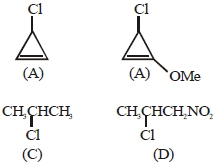
The decreasing order of reactivity of the following organic molecules towards $AgNO$ $_{3}$ solution is :
An alcoholic drink substance $pH = 4.7$ then $OH$ ion concentration of this solution is $({K_w} = {10^{ - 14}}\,mo{l^2}/\,{l^2})$
Benzoic acid is less acidic than salicylic acid because of
The hydrogen-like species $\mathrm{Li}^{2+}$ is in a spherically symmetric state $\mathrm{S}_1$ with one radial node. Upon absorbing light the ion undergoes transition to a state $\mathrm{S}_2$. The state $\mathrm{S}_2$ has one radial node and its energy is equal to the ground state energy of the hydrogen atom.

$1.$ The state $S_1$ is

$(A)$ $1 \mathrm{~s}$ $(B)$ $2 \mathrm{~s}$ $(C)$ $2 \mathrm{p}$ $(D)$ $3 \mathrm{~s}$

$2.$ Energy of the state $S_1$ in units of the hydrogen atom ground state energy is

$(A)$ $0.75$ $(B)$ $1.50$ $(C)$ $2.25$ $(D)$ $4.50$

$3.$ The orbital angular momentum quantum number of the state $S_2$ is

$(A)$ $0$ $(B)$ $1$ $(C)$ $2$ $(D)$ $3$

Give the answer question $1,2$ and $3.$

For the reaction, $C{O_{(g)}} + C{l_{2(g)}}$ $\rightleftharpoons$ $COC{l_{2(g)}}$ the ${K_p}/{K_c}$ is equal to
In which of the process entropy increases 

$(a)\,B{r_2}(l) \to B{r_2}(g)$

$(b)\,{H_2}O(s) \to {H_2}O(g)$ 

$(c)\,{N_2}\,\left[ {1\,atm,\,{{100}\,^o}C} \right] \to {N_2}\,\left[ {1\,atm,\,{{150}\,^o}C} \right]$

$(d)\,{N_2}\,(g) + 3{H_2}(g) \to 2N{H_3}(g)$

$(e)\,CaC{O_3}(s) \to CaO(s) + C{O_2}(g)$

The extra stability of half-filled subshell is due to
(A) Symmetrical distribution of electrons
(B) Smaller coulombic repulsion energy
(C) The presence of electrons with the same spin in non-degenerate orbitals
(D) Larger exchange energy
(E) Relatively smaller shielding of electrons by one another
Identify the correct statements
How many grams of $Ca{C_2}{O_4}$ will dissolve in distilled water to make one litre of saturated solution ? (Solubility product of $Ca{C_2}{O_4}$ is $2.5 \times {10^{ - 9}}\,mol{e^2}\,litr{e^{ - 2}}$ and its molecular weight is $128$)
Total number of acidic oxides among $N _2 O _3, NO _2, N _2 O , Cl _2 O _7, SO _2, CO , CaO , Na _2 O$ and $NO$ is $...........$