MCQ
Boyle's law holds for an ideal gas during
  • A
    Isobaric changes
  • Isothermal changes
  • C
    Isochoric changes
  • D
    Isotonic changes

Answer

Correct option: B.
Isothermal changes
b
Boyle's law states that at constant temperature, for a fixed mass of a gas, $PV$= constant

But if the temperature remains constant, it will be called as an isothermal change.

So $B$ is correct.

Need a full question paper?

Generate a complete, print-ready paper with questions like this in minutes — across 16+ boards, with answer keys.
Start Generating Free

Similar questions

The moment of inertia of a meter scale of mass $0.6\, kg$ about an axis perpendicular to the scale and  located at the $20\, cm$ position on the scale in $kg \,m^2$ is  (Breadth of the scale is negligible
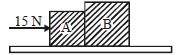
On a smooth plane surface (figure) two block $A$ and $B$ are accelerated up by applying a force $15\, N$ on $A$. If mass of $B$ is twice that of $A$, the force on $B$ is  ........... $N$
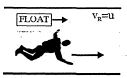
A swimmer can swim with speed '$v$' with respect to still water in a river which is flowing with speed $u$. There is a float moving with the river. Now the swimmer overtakes float and gets a lead of $l$ and returns back to the float. Time taken by swimmer in this process will be
If an electric fan is run in a heat-insulated closed room, then the temperature of the roons air will be:
If electronic charge $e$, electron mass $m$, speed of light in vacuum $c$ and Planck 's constant $h$ are taken as fundamental quantities, the permeability of vacuum $\mu _0$ can be expressed in units of
A block is thrown with a velocity of $2 ms^{^{-1}}$ (relative to ground) on a belt, which is moving with velocity $4 ms^{^{-1}}$ in opposite direction of the initial velocity of block. If the block stops slipping on the belt after $4 \,\,sec$ of the throwing then choose the correct statements (s)
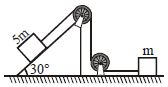
Acceleration of system is :-
Two unequal masses are tied together with a cord with a compressed spring in between. When the cord is burnt with a match releasing the spring, the two masses fly apart with equal
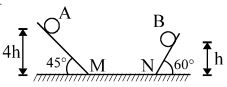
Two identical balls $A$ and $B$ are released from the positions shown in figure. They collide elastically on horizontal portion $MN$. All surfaces are smooth. The ratio of heights attained by $A$ and $B$ after collision will be(Neglect energy loss at $M$ & $N$)
In order to shift a body of mass $m$ from a circular orbit of radius $3R$ to a higher radius $5R$ around the earth, the work done is