Question
Briefly describe the following: Transcription

Answer

Transcription: Genetic informations are transferred from DNA to RNA. The process of synthesis of RNA from DNA is called transcription. DNA directs the synthesis of proteins. This DNA is found in nucleotide of prokaryotic cells and nucleus of eukaryotic cells. DNA molecules never leave their place and therefore DNA molecules code the messages of protein synthesis in mRNA which carries the message from nucleus to cytoplasm over ribosome therefore the synthesis of RNA on DNA template is called transcription. When mRNA is synthesized on DNA template, it contains Uracil in place of Thymine. This synthesis occurs in presence of enzyme RNA polymerase.
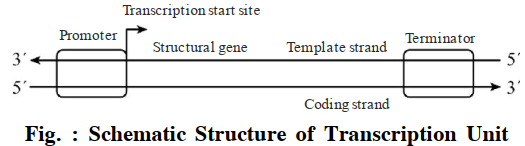
A segment of DNA that transcripts the RNA, is called Transcriptional unit. This unit may be like a gene or may have many continuous genes. There are three main components of transcriptional unit in DNA:
(1) Promoter,
(2) Structural gene,
(3) Terminator
DNA dependent RNA polymerase catalyses the polymerization in only one direction i.e. 5'→3'. The strand with 3'→5' polarity serves as template and is therefore, called template strand.
Image

The promoter and terminator flank the structural gene in a transcription unit. The promoter is said to be located towards S'-end (upstream) of the structural gene (the reference is made with respect to the polarity of coding strand). It is a DNA sequence that provides binding site for RNA polymerase, and it is the presence of a promoter in a transcription unit that also defines the template and coding strands. The terminator is located towards 3'-end (downstream) of the coding strand and it usually defines the end of the process of transcription. There are additional regulatory sequences that may be present further upstream or downstream to the promoter.

Need a full question paper?

Generate a complete, print-ready paper with questions like this in minutes — across 16+ boards, with answer keys.
Start Generating Free

Similar questions

Discuss the types of seeds. Also describe its structure.
Draw a labelled diagram of the sectional view of a mature pollen grain in angiosperms. Explain the functions of its different parts.
Trace the development of microspore mother cell in the anther to a mature pollen grain.
What is genetic engineering? List the steps involved in rDNA technology.
What are the methods of cancer detection? Describe the common approaches for treatment of cancer.
  1. Explain with the help of Griffith’s experiment how the search for genetic material was conducted and what was the conclusion drawn?
  2. How did MacLeod, McCarty and Avery establish the biochemical nature of the so called ‘genetic material’ identified by Griffith in his experiment.
Arun visited his grandfather's farm and noticed that one of the workers was introducing earthworms in the soil. He quickly rushed to his grandfather and asked him the reason. His grandfather explained him the advantages of earthworm in soil improvement.
  1. Why are earthworms also known as detritivores?
  2. Explain fragmentation.
  3. Name the steps in the process of decomposition.
  4. What values are shown by Arun?
  1. What is an age pyramid?
  2. Explain with the help of figures, the three different types of age pyramids represented by human population.
In the medium where E. coli was growing. lactose was added, which induced the lac operon. Then, why does lac operon shut down some time after addition of lactose in the medium.
  1. State the cause and symptoms of colour-blindness in humans.
  2. Statistical data has shown that 8% of the human males are colour-blind whereas only 0.4% of females are colour-blind. Explain giving reasons how is it so.