Question
Briefly describe the following: Transcription

Answer

Transcription: Genetic informations are transferred from DNA to RNA. The process of synthesis of RNA from DNA is called transcription. DNA directs the synthesis of proteins. This DNA is found in nucleotide of prokaryotic cells and nucleus of eukaryotic cells. DNA molecules never leave their place and therefore DNA molecules code the messages of protein synthesis in mRNA which carries the message from nucleus to cytoplasm over ribosome therefore the synthesis of RNA on DNA template is called transcription. When mRNA is synthesized on DNA template, it contains Uracil in place of Thymine. This synthesis occurs in presence of enzyme RNA polymerase.
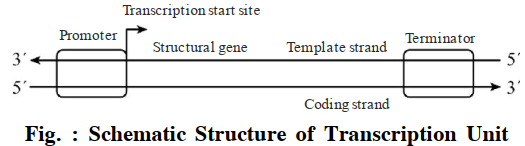
A segment of DNA that transcripts the RNA, is called Transcriptional unit. This unit may be like a gene or may have many continuous genes. There are three main components of transcriptional unit in DNA:
(1) Promoter,
(2) Structural gene,
(3) Terminator
DNA dependent RNA polymerase catalyses the polymerization in only one direction i.e. 5'→3'. The strand with 3'→5' polarity serves as template and is therefore, called template strand.
Image

The promoter and terminator flank the structural gene in a transcription unit. The promoter is said to be located towards S'-end (upstream) of the structural gene (the reference is made with respect to the polarity of coding strand). It is a DNA sequence that provides binding site for RNA polymerase, and it is the presence of a promoter in a transcription unit that also defines the template and coding strands. The terminator is located towards 3'-end (downstream) of the coding strand and it usually defines the end of the process of transcription. There are additional regulatory sequences that may be present further upstream or downstream to the promoter.

Need a full question paper?

Generate a complete, print-ready paper with questions like this in minutes — across 16+ boards, with answer keys.
Start Generating Free

Similar questions

What is meant by the term bio-pesticide? Name and explain the mode of action of a popular bio-pesticide.
Which property of DNA double helix led Watson and Crick to hypothesise semi-conservative mode of DNA replication? Explain.
Pragyan takes fruits, vegetables, bread and egg curry in a day's menu. While his teacher was giving a lecture on trophic level, he got fascinated and asked following questions from his teacher.
  1. How many trophic levels does he occupy in different food chains?
  2. Represent atleast three food chains.
  3. Which among them gives him the maximum amount of energy? Give reason.
  4. What values are shown by Pragyan?
Discuss the types of seeds. Also describe its structure.
Describe the roles of pitutary and ovarian hormones during the menstrural cycle in human female.###Explain the various phases of menstrual cycle. Give a diagrammatic representation of various events during a menstrual cycle.
Comment on the growth curve given below.

A flower of tomato plant following the process of sexual reproduction produce 240 viable seeds.
Answer the following questions giving reasons:
What is the minimum number of pollen grains that must have been involved in the pollination of its pistil?
What is a biogeochemical cycle. What is the role of the reservoir in a biogeochemical cycle. Give an example of a sedimentary cycle with reservoir located in earth’s crust.
(a) Write the features that a biomolecule must fulfill to be able to act as a genetic material.
(b) DNA and RNA are both genetic materials. Which one of the two is more stable and why?
Or
Stability of DNA is higher than that of RNA. How?
Answer the following questions:
Explain Polygenic inheritance and Multiple allelism with the help of suitable examples.