Question
Briefly explain IVF and ET What are the conditions in which these methods are advised?

Answer

IVF stands for in-vitro fertilization. In this technique, sperm from the male (or donor) and ovum from the female (or donor) are taken out. Ovum is then fertilized in the laboratory; usually in a petri dish. ET stands for embryo transfer and is the next procedure after IVF. Embryo up to 8 blastomere stage is transferred in the fallopian tube. Embryo with more than 8 blastomeres is transferred to the uterus. Since, the technique involves carrying out fertilization and some development of zygote in the laboratory hence babies born out of this method are often called test tube babies. These methods are parts of Assisted Reproductive Technologies (ART). These methods are employed when medical treatment and psychotherapy may have failed in helping the couple in conception. These methods require very high degree of precision and can only be carried out by highly specialized doctors. Moreover, employing these technologies require costly equipments. Hence, facilities for IVF or ET are available only at select centres across the country.
Need a full question paper?

Generate a complete, print-ready paper with questions like this in minutes — across 16+ boards, with answer keys.

Start Generating Free

Similar questions

What criteria should one use in categorizing a species as threatened?
When someone buys packets of cigarettes, cannot miss the statutory warning that is present on the packing which warns against smoking and says how it is injurious to health. Yet, smoking is very prevalent in our society, both among young and old. Advise the adolescents about the importance of avoiding smoking. (Mention any six points.)
Because 'health is the best wealth', we should make efforts to maintain good health. List any six ways to achieve good health.
Two children, A and B aged 4 and 5 years respectively visited a hospital with a similar genetic disorder. The girl A was provided enzyme-replacement therapy and was advised to revisit periodically for further treatment. The girl, B was, however, given a therapy that did not require revisit for further treatment.
  1. Name the ailments the two girls were suffering from?
  2. Why did the treatment provided to girl A required repeated visits?
  3. How was the girl B cured permanently?
A 250kg cow produces 200g of protein per day but 250g of Methylophillus methylotrophus can produce 25 tonnes of protein Name this emerging area of research. Explain its benefits.
What is meant by metastasis? ### Give difference between Benign and Malignant cancer and explain the agents responsible for transformation of Normal cells into cancerous cells.
Explain into how many categories the endangered species have been classified on the basis of threatened species.
Name any six venereal diseases.
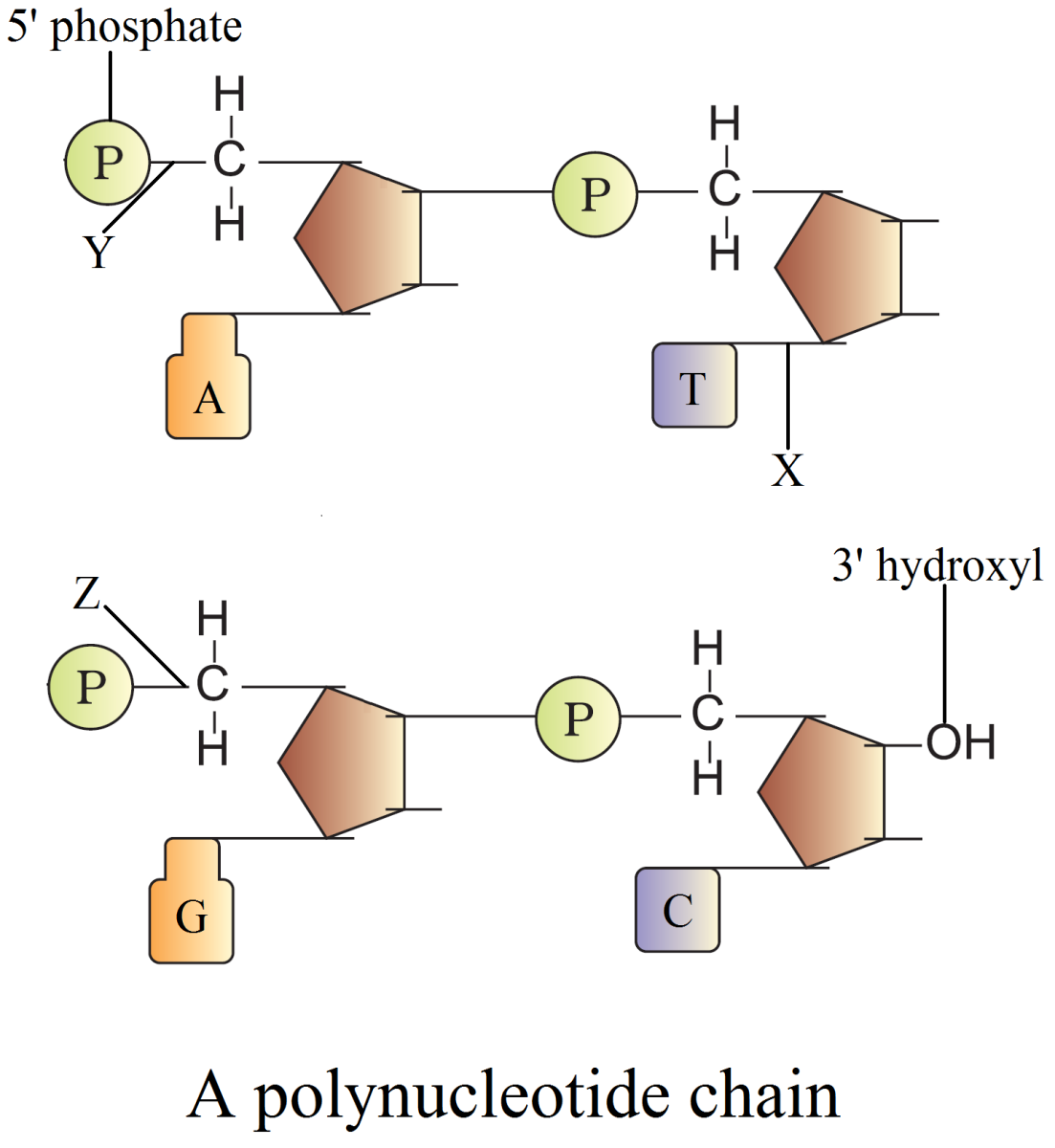
Study the diagram given below.

Name the linkage X, Y, Z and the respective molecules formed by them.
Explain how PCR technique can be used for amplification of a small amount of DNA template.