Question
Briefly explain the guidelines for preparing a good table.

Answer

A good table is one which is able to convey the required information effectively. The guidelines for preparing a good table are stated below:
  1. Simple and Compact: The table should be simple and compact, so that it should not create confusion in the mind of the user.
  2. Focus Attention on Main Comparisons: The data in the table should be arranged so that it focuses attention on the main comparisons and clearly exhibits the relationship between various related items. For this, different fonts of lettering (italic, bold, capital letters, etc) may be used.
  3. Complete and Self-Explanatory: A table should be complete and self-explanatory. It should contain all the essential parts of a table. Also, in the preparation of table, use of abbreviations should be avoided. Only common abbreviations should be used.
  4. Attractive: A table should be designed so that it is neither too long or narrow, nor too broad or short. If the data is very large, it should not be crowded in a single table, rather a number of different tables of reasonable size and shape should be prepared. All this helps in attractive presentation of data.
  5. Accurate and Free from Errors: The data contained in the table should be accurate and free from errors. For this, the entries in the table should be checked and re-checked.
  6. Classification According to a Specific Attribute: The classification of data in a table should be according to a specific attribute.

Need a full question paper?

Generate a complete, print-ready paper with questions like this in minutes — across 16+ boards, with answer keys.

Start Generating Free

Similar questions

Calculate mean deviation using median and coefficient of mean deviation:
Class: 5-15 15-25 25-35 35-45 45-55
Frequency: 5 4 5 4 2
Represent the following data by means of a frequency polygon:
Wages (in ₹)
325-350
350-375
375-400
400-425
425-450
No. of woekers
20
45
60
35
10
What do you understand by equilibrium price? How do the forces of demand and supply determine the equilibrium price?
Calculate the arithmetic mean from the following series.
Marks
5-15
15-25
25-35
35-45
45-55
No. of Students
8
12
15
9
6
State any four uses of different types of Index Numbers.
Explain the conditions of consumer's equilibrium with the help of marginal utility analysis
Calculate the value of median, first quartile $(Q_1)$ and third quartile $(Q_3)$ from the following data.
Marks
Number of Students
30-35
14
35-40
16
40-45
18
45-50
23
50-55
18
55-60
8
60-65
3
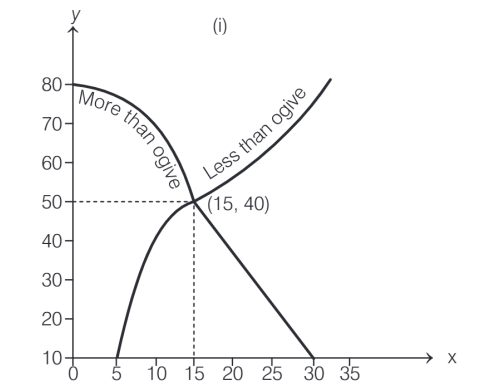
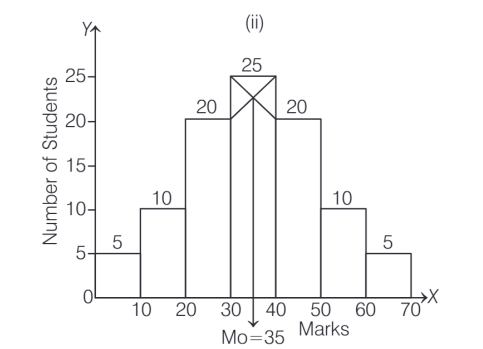
Direction Analyse the following case study graphs and answer questions (i) to (v) on the basis of the same.

  1. According to figure one, value of median is equal to .........
  1. 15
  2. 20
  3. 30
  4. 40
  1. Median can be located graphically using which of the following?
  1. Less than ogive.
  2. More than ogive.
  3. Both less than ogive and more than ogive together.
  4. All of the above.
  1. Which form of graphical presentation is used to locate mode?
  1. Histogram
  2. Bar graphs
  3. Cumulative curves
  4. Arithmetic line graphs
  1. According to figure two, the approxi- mate value of mode is equal to .........
  1. 25
  2. 35
  3. 45
  4. Can't be determined
  1. What will be the mean value in case 1?
  1. 10
  2. 15
  3. 25
  4. None of the above
Following table gives the distribution of companies according to the size of capital. Using step deviation method, find out the mean size of the capital of a company.
Capital (₹ in lakh)
Less than 5
Less than 10
Less than 15
Less than 20
Less than 25
Less than 30
Number of Companies
20
27
29
38
48
53
Hint: In the above problem, cumulative frequenices are given, we first find the simple frequencies and thereafter we will calculate arithmetic mean.
The yield of wheat and rice per acre for $10$ districts of a state is as under:
District
1
2
3
4
5
6
7
8
9
10
Wheat
12
10
15
19
21
16
18
9
25
10
Rice
22
29
12
23
18
15
12
34
18
12
Calculate for crop.
Q.D.