Question
Briefly list the generic considerations before sourcing an accounting software.

Answer

The following factors are usually taken into consideration before sourcing an accounting software:
  1. The cost of installation and maintenance: The cost of installation and maintenance: A simple cost benefit analysis is done before installing any software. The cost of its aquisition, installation and maintenance are the factors of deep consideration before sourcing any software.
  2. Flexibility: It is one of the important considerations before sourcing an accounting software. The software should be easily upgradable and must have the feature of easy modifications.
  3. Adaptability and Training needs: Adaptabits and framing needs: The accounting software should be easily understandable and adaptable. It must not require extensive training.
  4. Size of the orgnisation: The size of the organisation and the volume of its accounting transactions determine the requirements of the type of accounting software.
  5. The Level of MIS reporting: Thilak u s reporting The level of use and utility of MIS reporting in an organisation determine the acquisition of software to a lot of extent.
  6. Level of Secrecy: The level of secrecy should be high. It should be impossible for any unauthorised user to access the data.
  7. Vendors Reputation and Capability: Another very important consideration to be made before sourcing any software is the various information about the vendor -- like since when the vendor is in the business of software development? Whether there are other users of the same software or not? What is the after sale service the vendor is offering and how quick is his service? etc.

Need a full question paper?

Generate a complete, print-ready paper with questions like this in minutes — across 16+ boards, with answer keys.

Start Generating Free

Similar questions

Krishan started his business on 1st April, 2018 with a Capital of ₹ 1,00,000. On 31st March, 2019, his assets were:
 
Cash 3,200
Stock 34,800
Debtors 31,000
Plant 85,000
He owed ₹ 12,000 to sundry creditors and ₹ 10,000 to his brother on that date. He withdrew ₹ 2,000 per month for his personal expenses. Ascertain his profit.
Define a computerised accounting system. Distinguish between a manual and computerised accounting system.
On checking the Bank Pass Book it was found that it showed an overdraft of ₹ 5,220 as on 31st March, 2019, while as per Ledger it was different. The following differences were noted:
  1. Cheques deposited but not yet credited by the bank ₹ 6,000.
  2. Cheques dishonoured and debited by the bank but not given effect to it in the Ledger ₹ 800.
  3. Bank charges debited by the bank but Debit Memo not received from the bank ₹ 50.
  4. Interest on overdraft excess credited in the Ledger ₹ 200.
  5. Wrongly credited by the bank to account, deposit of some other party ₹ 900.
  6. Cheques issued but not presented for payment ₹ 400.
Describe the various types of accounting software along with their advantages and limitations.
Following incomplete information is available from records maintained by Mr. X:

During the year Mr. X introduced in the business the amount realised on sale of ₹ 10,000 investments at the premium of 5%. Personal expenses of Mr. X paid from business account amounted to ₹ 1,250 per month. Prepare a statement to calculate Profit (or Loss) during the year.
Briefly state the purpose of functions in SQL environment.
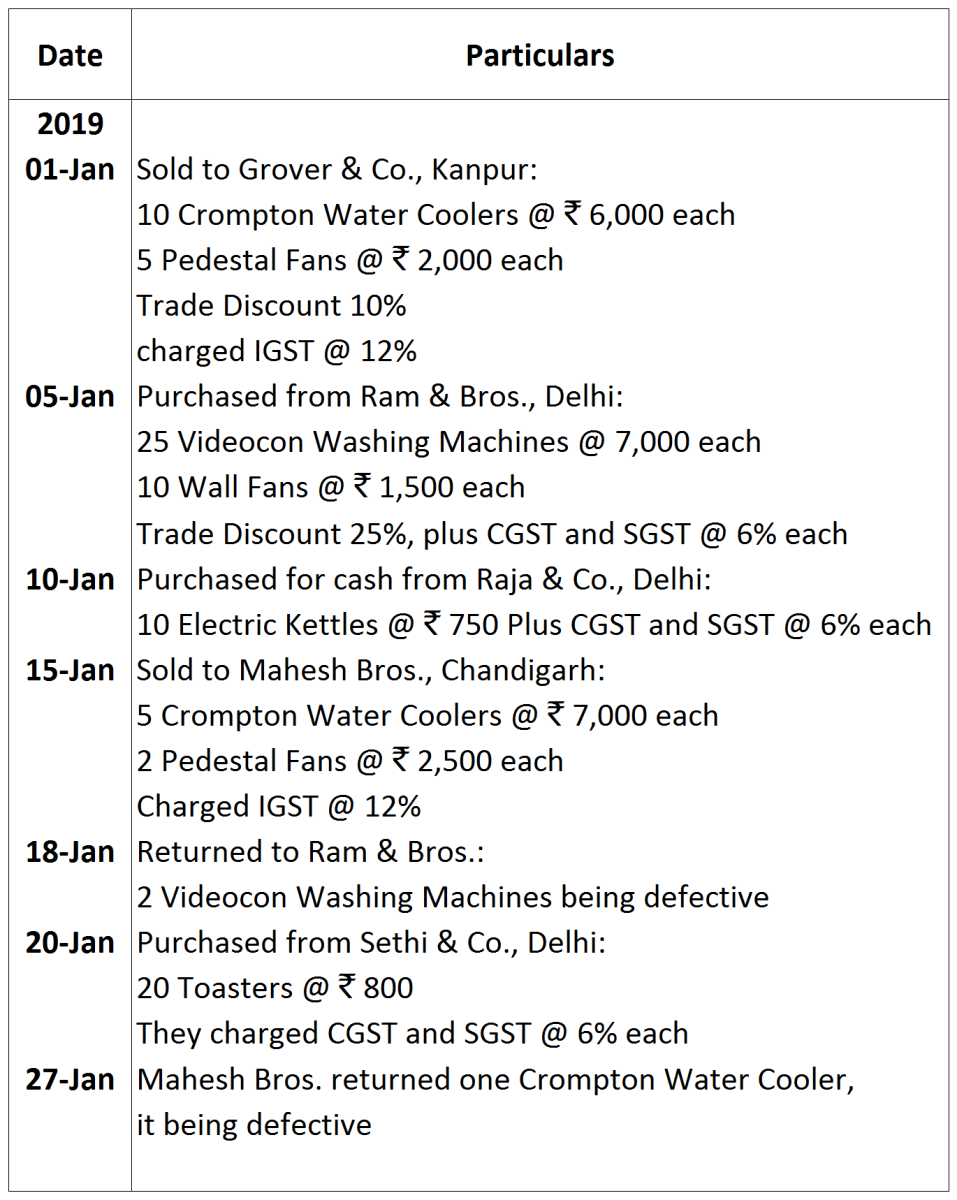
​Record the following transactions of Prabhat Electric Co., Delhi in the proper subsidiary books:
Vardhman commenced business on $1^{st} $ April, $2018$, with a capital of $₹\ 50,000.$ He immediately purchased furniture of $₹\ 20,000.$ During the year he received from his uncle a gift of $₹\ 3,000$ and he borrowed from his father a sum of $₹\ 5,000.$ He had withdrawn $₹\ 600$ per month for his household expenses. He had no Bank account and all dealings were in cash. He did not maintain any books but following information is given :
He used goods worth $₹\ 1,300$ for personal purposes and paid $₹\ 500 $ to his son for examination and college fees. On $31^{st}$ March, $2019$, his Debtors were worth $₹\ 21,000$ and Creditors $₹\ 15,000. $ Stock in trade was valued at $₹\ 10,000.$ Furniture to be depreciated by $10%$ p.a. Prepare Trading and Profit and Loss Account for the year ended on $31^{st}$ March, $2019$, and Balance Sheet as at $31^{st}$ March, $2019.$
Ashok keeps incomplete records. The position of his business on $1^{st}$ April, $2016$ was as follows: Cash in Hand ₹ $2,200$; Cash at Bank ₹ $5,400$; Stock ₹ $25,100$; Sundry Debtors ₹ $18,700$; Furniture ₹ $6,000$; Sundry Creditors ₹ $13,500$. His position on $31^{st}$ March, $2017$ was as follows: Cash in Hand ₹ 1,500; Cash at Bank ₹ $8,400$; B/R ₹ $3,300$; Stock ₹ $26,000$; Sundry Debtors ₹ $24,600$; Furniture ₹ $8,000$; Sundry Creditors ₹ $14,200$. During the year he had withdrawn from the business ₹ $18,000$, of which ₹ $9,200$ were spent in purchasing a Typewriter for the business.
  1. Depreciate furniture and typewriter by $10\%$.
  2. Write off ₹ $600$ as Bad-Debts.
  3. Make a provision of $5\%$ on Debtors for doubtful debts.
Calculate the profit or loss of his business for the year ended $31^{st}$ March, $2017$ and prepare a final statement of affairs, after the above adjustments.
Briefly explain three advantages and three disadvantages of computerised accounting.