Question
Broadcasting antennas are generally

Answer

(b)

Need a full question paper?

Generate a complete, print-ready paper with questions like this in minutes — across 16+ boards, with answer keys.
Start Generating Free

Similar questions

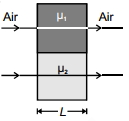
Two light rays initially in same phase travel through two media of equal length $L$ having refractive index $m _1$ and $m_2\left(m_1 > m_2\right)$ as shown in figure. If the wave length of light rays in air is $1$ , the phase difference of the emerging rays is given by
The longest wavelength associated with Paschen series is : (Given $R_H=1.097 \times 10^7 \mathrm{SI}$ unit)
A certain stable nucleide, after absorbing a neutron, emits $\beta$-particle and the new nucleide splits spontaneously into two $\alpha$-particles. The nucleide is
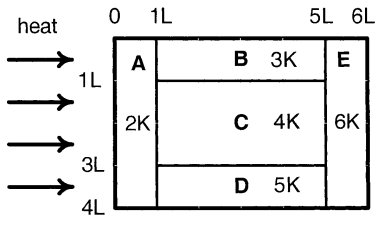
A composite block is made of slabs $A, B, C, D$ and $E$ of different thermal conductivities (given in terms of a constant $K$ ) and sizes (given in terms of length, $L$ ) as shown in the figure. All slabs are of same width. Heat $'Q'$ flows only from left to right through the blocks. Then in steady state $Image$

$(A)$ heat flow through $A$ and $E$ slabs are same.

$(B)$ heat flow through slab $E$ is maximum.

$(C)$ temperature difference across slab $E$ is smallest.

$(D)$ heat flow through $C =$ heat flow through $B +$ heat flow through $D$.
If first excitation potential of a hydrogen like atom is $V\, volt$, then the ionization energy of this atom will be
Mean life of a radioactive sample is $100$ seconds. Then its half life (in minutes) is
A ball moving with a velocity of $6\, m/s$ strikes an identical stationary ball. After collision each ball moves at an angle of $30^o$ with the original line of motion. What are the speeds of the balls after the collision ?
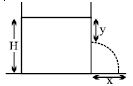
Acylindrical vessel is filled with a liquid up to height H.A small hole is made in the vessel at a distance $y$ below the liquid surface as shown in figure. The liquid emerging from the hole strike the ground at distance $x$
Energy of electrons can be increased by allowing them
A particle of mass $1 \,{mg}$ and charge $q$ is lying at the mid-point of two stationary particles kept at a distance $'2 \,{m}^{\prime}$ when each is carrying same charge $'q'.$ If the free charged particle is displaced from its equilibrium position through distance $'x'$ $(x\,< \,1\, {m})$. The particle executes $SHM.$ Its angular frequency of oscillation will be $....\,\times 10^{8}\, {rad} / {s}$ if ${q}^{2}=10\, {C}^{2}$