MCQ
Bromination take place at
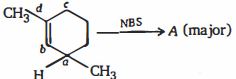
- ✓$a$
- B$b$
- C$c$
- D$d$
$\therefore$ formation of stable $3^o$ free radical at $(a)$
$\therefore$ Bromination of $(a)$ is most favourable.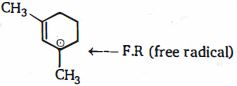
Generate a complete, print-ready paper with questions like this in minutes — across 16+ boards, with answer keys.
|
List$-I$ (Si-Compounds) |
List$-II$ (Si-Polymeric/other products) |
| $(A)$ $\left( CH _{3}\right)_{4} Si$ | $(I)$ Chain silicone |
| $(B)$ $\left( CH _{3}\right) Si ( OH )_{3}$ | $(II)$ Dimeric silicone |
| $(C)$ $\left( CH _{3}\right)_{2} Si ( OH )_{2}$ | $(III)$ Silane |
| $(D)$ $\left( CH _{3}\right)_{3} Si ( OH )$ | $(IV)$ $2 D$ - Silicone |
Choose the correct answer from the options given below
| $LIST-I$ | $LIST-II$ |
| $(I)$ Aniline | $(P)$ Sodium fusion extract of the compound on boiling with $FeSO _4$, followed by acidification with conc. $H _2 SO _4$, gives Prussian blue color. |
| $(II)$ o-Cresol | $(Q)$ Sodium fusion extract of the compound on treatment with sodium nitroprusside gives blood red color. |
| $(III)$ Cysteine | $(R)$ Addition of the compound to a saturated solution of $NaHCO _3$ results in effervescence. |
| $(IV)$ Coprolactam | $(S)$ The compound reacts with bromine water to give a white precipitate. |
| $(T)$ Treating the compound with neutral $FeCl _3$ solution produces violet color. |