MCQ
By graphical method, the solution of linear programming problem
Maximize $Z = 3x_1 + 5x_2$
Subject to
$3x_1 + 2x_2 \leq 18$
$x_1 \leq 4$
$x_2 \leq 6$
$x1 \geq 0, x2 \geq 0,$ is:
  • A
    $x_1 = 2, x_2 = 0, Z = 6$
  • $x_1 = 2, x_2 = 6, Z = 36$
  • C
    $x_1 = 4, x_2 = 3, Z = 27$
  • D
    $x_1 = 4, x_2 = 6, Z = 42$

Answer

Correct option: B.
$x_1 = 2, x_2 = 6, Z = 36$
We need to maximize the function $Z = 3x_4 + 5x_2$
First, we will convert the given inequations into equations, we obtain the following equations:
$3x_1 + 2x_2 = 18, x_1 = 4, x_2 = 6, x_1 = 0$ and $x_2 = 0$
Region represented by $3x_1 + 2x_2 \leq 18:$
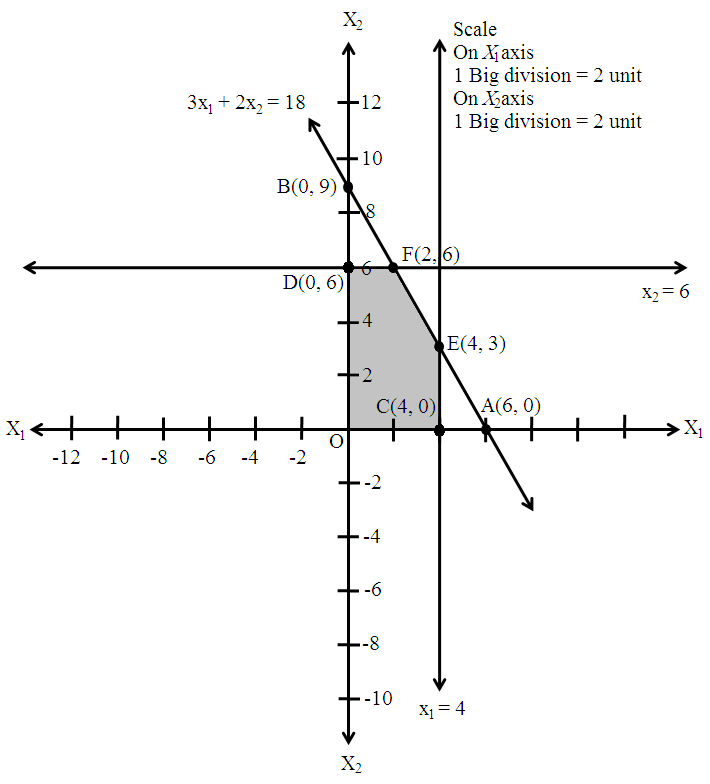
The line $3x_1 + 2x_2 = 18$ meets the coordinate axes at $A(6, 0)$ and $B(0, 9)$ respectively.
By joining these points we obtain the line $3X1 + 2x2 = 18.$
Clearly $(0, 0)$ satisfies the inequation $3x_1 + 2x_2 = 18.$
So the region in the plane which contain the origin represents the solution set of the inequation$ 3x_1 + 2x_2 \leq 18.$
Region represented by $x_1 \leq 4:$
The line $x_1 = 4$ is the line that passes through $C(4, 0)$ and is parallel to the $Y$ axis.
The region to the left of the line $x_1 = 4$ will satisfy the inequation $x_1 \leq 4.$
Region represented by $x_2 \leq 6:$
The line $x_2 = 6$ is the line that passes through $D(0, 6)$ and is parallel to the $X$ axis.
The region below the line $x_2 = 6$ will satisfy the inequation $X_2 \leq 6.$
Region represented by $x_1 \geq 0$ and $x_2 \geq 0:$
Since, every point in the first quadrant satisfies these inequations.
So, the first quadrant is the region represented by the inequations $x_1 \geq 0$ and $x_2 \geq 0.$
The feasible region determined by the system of constraints,$ 3x_1 + 2x_2 \leq 18, x_1 \leq 4, x_2 \leq 6, x_1 \geq 0$ and $x_2 \geq 0$ are as follows

Corner points are $O(0, 0), D(0, 6), F(2, 6), E(4, 3)$ and $C(4, 0).$
The values of the objective function at these points are given in the following table.
Points
Value of $Z$
$O(0, 0)$ $3(0) + 5(0) = 0$
$D(0, 6)$ $3(0) + 5(6) = 30$
$F(2, 6)$ $3(2) + 5(6) = 36$
$E(4, 3)$ $3(4) + 5(3) = 27$
$C(4, 0)$ $3(4) + 5(0) = 12$
We see that the maximum value of the objective function $Z$ is $36$ which is at $F(2, 6).$

Need a full question paper?

Generate a complete, print-ready paper with questions like this in minutes — across 16+ boards, with answer keys.

Start Generating Free

Similar questions

If $\text{f(x)}=\begin{cases}\frac{1-\sin^2\text{x}}{3\cos^2\text{x}},&\text{if}\text{ x}<\frac{\pi}{2}\\\text{a},&\text{if}\text{ x}=\frac{\pi}{2}\\\frac{\text{b}(1-\sin\text{x})}{(\pi-2\text{x})^2},&\text{if}\text{ x }>\frac{\pi}{2}\end{cases}$ Then f(x) is continuous at $\text{x}=\frac{\pi}{2},$ if:
  1. $\text{a}=\frac{1}{3},\text{ b}=2$
  2. $\text{a}=\frac{1}{3},\text{ b}=\frac{8}{3}$
  3. $\text{a}=\frac{2}{3},\text{ b}=\frac{8}{3}$
  4. none of these
$\int\limits^\pi_0\sqrt{\frac{1-\text{x}}{1+\text{x}}}\text{ dx}=$
  1. $\sqrt{1-\pi^2}-1$
  2. $\frac{\pi}{2}-1$
  3. $\frac{\pi}{2}+1$
  4. ${\pi}+{1}$
Area of the region bounded by the curve $\text{y}=\cos\text{x}$ between x = 0 and $\text{x}=\pi$ is:
  1. 2 sq. units
  2. 4 sq. units
  3. 3 sq. units
  4. 1 sq. units
The equation of the plane passing through the points (3, 2, −1), (3, 4, 2) and (7, 0, 6) is 5x + 3y −2z = λ where λ is:
The solution of the equation $\frac{d y}{d x}=\cos ^2 y$ is :
 The area of the region bounded by the $\text{ellipse }\frac{\text{x}\ ^2}{25}+\frac{\text{y}^2}{16}=1\text{ is:}$
  1. $25\pi\text{ sq.}\text{ units}$
  2. $20\pi^2\text{ sq.}\text{ units}$
  3. $16\pi^2\text{ sq.}\text{ units}$
  4. $25\pi\text{ sq.}\text{ units}$
The function $\text{f(x)=}\begin{cases}\frac{\text{e}\frac{1}{\text{x}}-1}{\text{e}\frac{1}{\text{x}}+1},&\text{x}\neq0\\0,&\text{x}=0\end{cases}$
  1. is continuous at x = 0
  2. is not continuous at x = 0
  3. is not continuous at x = 0, but can be made continuous at x = 0
  4. none of these.
 The solution of the differential equation $\frac{\text{dy}}{\text{dx}}+\frac{2\text{y}}{\text{x}}=0$ with y(1) = 1 is given by.
  1. $\text{y}=\frac{1}{\text{x}^{2}}$
  2. $\text{x}=\frac{1}{\text{y}^{2}}$
  3. $\text{x}=\frac{1}{\text{y}}$
  4. $\text{y}=\frac{1}{\text{x}}$ 
To write the dual; it should be ensured that
  1.  All the primal variables are non - negative.
  2. All the bi values are non - negative.
  3. All the constraints are $\leq$ type if it is maximization problem and $\geq$ type if it is a minimization problem.
Let R be a relation on the set N of natural numbers defined by nRm if n divides m. Then, R is:
  1. Reflexive and symmetric.
  2. Transitive and symmetric.
  3. Equivalence.
  4. Reflexive, transitive but not symmetric.