MCQ
By graphical method, the solution of linear programming problem
Maximize $Z = 3x_1 + 5x_2$
Subject to
$3x_1 + 2x_2 \leq 18$
$x_1 \leq 4$
$x_2 \leq 6$
$x1 \geq 0, x2 \geq 0$, is:
  • A
    $x_1 = 2, x_2 = 0, Z = 6$
  • $x_1 = 2, x_2 = 6, Z = 36$
  • C
    $x_1 = 4, x_2 = 3, Z = 27$
  • D
    $x_1 = 4, x_2 = 6, Z = 42$

Answer

Correct option: B.
$x_1 = 2, x_2 = 6, Z = 36$
We need to maximize the function $Z = 3x_4 + 5x_2$
First, we will convert the given inequations into equations, we obtain the following equations:
$3x_1 + 2x_2 = 18, x_1 = 4, x_2 = 6, x_1 = 0$ and $x_2 = 0$
Region represented by $3x_1 + 2x_2 \leq 18:$
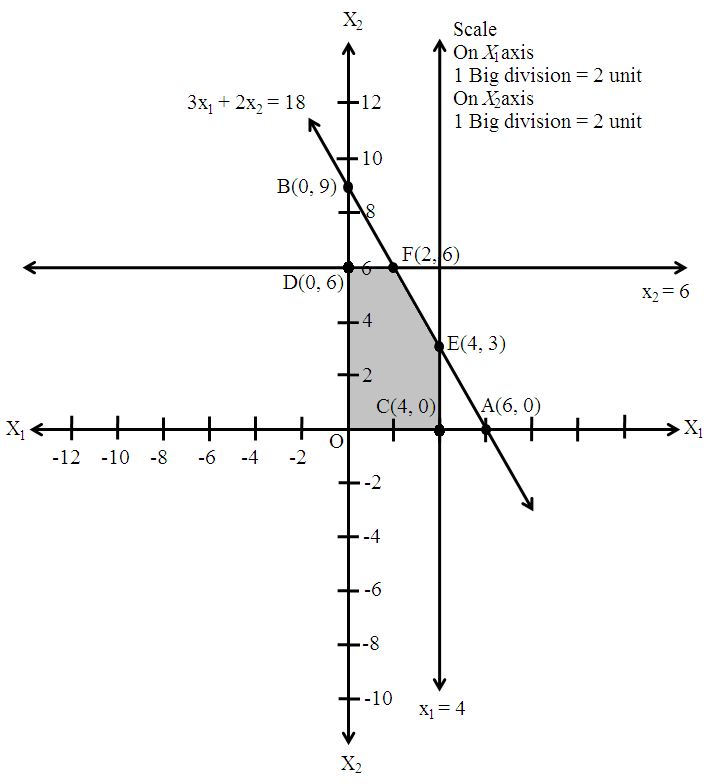
The line $3x_1 + 2x_2 = 18$ meets the coordinate axes at $A(6, 0)$ and $B(0, 9)$ respectively.
By joining these points we obtain the line $3X1 + 2x2 = 18.$
Clearly $(0, 0)$ satisfies the inequation $3x_1 + 2x_2 = 18.$
So the region in the plane which contain the origin represents the solution set of the inequation $3x_1 + 2x_2 \leq 18.$
Region represented by $x_1 \leq 4:$
The line $x_1 = 4$ is the line that passes through $C(4, 0)$ and is parallel to the $Y$ axis.
The region to the left of the line $x_1 = 4$ will satisfy the inequation $x_1 \leq 4.$
Region represented by $x_2 \leq 6:$
The line $x_2 = 6$ is the line that passes through $D(0, 6)$ and is parallel to the $X$ axis.
The region below the line $x_2 = 6$ will satisfy the inequation $X_2 \leq 6.$
Region represented by $x_1 \geq 0$ and $x_2 \geq 0:$
Since, every point in the first quadrant satisfies these inequations.
So, the first quadrant is the region represented by the inequations $x_1 \geq 0$ and $x_2 \geq 0.$
The feasible region determined by the system of constraints, $3x_1 + 2x_2 \leq 18, x_1 \leq 4, x_2 \leq 6, x_1 \geq 0$ and $x_2 \geq 0$ are as follows
  
Corner points are $O(0, 0), D(0, 6), F(2, 6), E(4, 3)$ and $C(4, 0).$
The values of the objective function at these points are given in the following table.
Points
Value of Z
$O(0, 0)$
$3(0) + 5(0) = 0$
$D(0, 6)$
$3(0) + 5(6) = 30$
$F(2, 6)$
$3(2) + 5(6) = 36$
$E(4, 3)$
$3(4) + 5(3) = 27$
$C(4, 0)$
$3(4) + 5(0) = 12$
We see that the maximum value of the objective function $Z$ is $36$ which is at $F(2, 6).$

Need a full question paper?

Generate a complete, print-ready paper with questions like this in minutes — across 16+ boards, with answer keys.

Start Generating Free

Similar questions

The matrix $\text{A}=\begin{bmatrix}0&-5&8\\5&0&12\\-8&-12&0\end{bmatrix}$ is a:
The least number of times a fair coin must be tossed so that the probability of getting at least one head is at least $0.8,$ is :
The maximum value of the term independent of $'t'$ in the expansion of $\left( tx ^{\frac{1}{5}}+\frac{(1- x )^{\frac{1}{10}}}{ t }\right)^{10}$ where $x \in(0,1)$ is
Let $S=(-1, \infty)$ and $f: S \rightarrow \mathbb{R}$ be defined as $f(x)=\int_{-1}^x\left(e^1-1\right)^{11}(2 t-1)^5(t-2)^7(t-3)^{12}(2 t-10)^{61} d t$ Let $p=$ Sum of square of the values of $x$, where $\mathrm{f}(\mathrm{x})$ attains local maxima on $\mathrm{S}$. and $\mathrm{q}=$ Sum of the values of $x$, where $f(x)$ attains local minima on $S$. Then, the value of $p^2+2 q$ is
Let $f : R \rightarrow R$ be defined as $\text{f(x)}=\begin{cases}2\text{x},&\text{if x}>3\\\text{x}^2,&\text{if }1<\text{x}\leq3\\3\text{x},&\text{if x}\leq1\end{cases}.$ Then, find $f(-1) + f(2) + f(4):$
Side of an equilateral triangle expands at the rate of $2\text{cm}/ \text{sec}.$ The rate of increase of its area when each side is 10cm is:
Choose the correct answer from the given four option.Solution of $\frac{\text{d}\text{y}}{\text{d}\text{x}}-\text{y}=1,\text{ y}(0)=1$ is given by:
Let the function $\mathrm{g}:(-\infty, \infty) \rightarrow\left(-\frac{\pi}{2}, \frac{\pi}{2}\right)$ be given by $g(\mathrm{u})=2 \tan ^{-1}\left(e^{\mathrm{u}}\right)-\frac{\pi}{2}$. Then, $\mathrm{g}$ is
$\int\frac{\cos2\text{x}-\cos2\theta}{\cos\text{x}-\cos\theta}\text{ dx}$ is equal to:
If $a = (1,\,\,1,\,\,1),\,\,c = (0,\,\,1,\,\, - 1)$ are two vectors and $b$ is a vector such that $a \times b = c$ and $a\,.\,b = 3,$ then $b$ is equal to