MCQ
By knowing the number of protons in a neutral atom, one can determine:
  • A
    The identity of the element.
  • B
    The number of neutrons in the atom.
  • C
    The number of common isotopes of the element.
  • D
    The atomic radius size.

Answer

  1. The identity of the element.

Explanation:

In a neutral atom, the number of protons is always the atomic number of the element and uniquely identifies the element. and in this, the number of positive protons and negative electrons is always equal.

Need a full question paper?

Generate a complete, print-ready paper with questions like this in minutes — across 16+ boards, with answer keys.

Start Generating Free

Similar questions

What will be the conjugate bases for the following Bronsted acids?
$\text{HF}, \text{H}_2\text{SO}_4 \text{ and }\text{HCO}^-_3$
For a given exothermic reaction, $K_p$ and $K'_p$  are the equilibrium constants at temperatures $T_1$ and $T_2,$ respectively. Assuming that heat of reaction is constant in temperature range between $T_1$ and $T_2,$ it is readily observed that
Which one of the following is not isoelectronic with ${O^{2 - }}$
Electronic configuration of $S{c^{21}}$ is
Which compound is optically active
Assuming ideal behaviour, the magnitude of $log \, K$ for the following reaction at $25^{\circ} C$ is $x \times 10^{-1} .$ The value of $x$ is $...... .$ (Integer answer)

$3 HC \equiv CH _{( g )} \rightleftharpoons C _{6} H _{6(\ell)}$

[Given: $\Delta_{f} G ^{\circ}( HC \equiv CH )=-2.04 \times 10^{5}\, J mol ^{-1}$

$\Delta_{f} G ^{\circ}\left( C _{6} H _{6}\right)=-1.24 \times 10^{5}\, J mol ^{-1} ; R =8.314\,\left. J K ^{-1} mol ^{-1}\right]$

Which of the following statements is not correct for a nucleophile?
Consider, $PF _{5}, BrF _{5}, PCl _{3}, SF _{6},\left[ ICl _{4}\right]^{-}, ClF _{3}$ and $IF _{5}$

Amongst the above molecule(s)/ion(s), the number of molecule(s)/1on(s) having $sp ^{3} d ^{2}$ hybridisation is $........$
If the value of equilibrium constant for a particular reaction is $1.6 \times 10^{12}$ then at equilibrium the system will contain
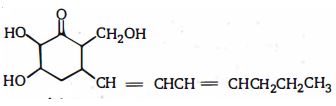
A naturally occurring substance has the constitution shown below. How many may  have this constitution ?