MCQ
By studying analogous structures we look for :
  • Similarities in organ structure.
  • B
    Similarities in cell make-up.
  • C
    Similarities in appearance and function different in structure.
  • D
    Similarities in appearance that differences in functions.

Answer

Correct option: A.
Similarities in organ structure.
Analogous structures are structures that are similar in unrelated organisms. The structures are similar because they evolved to do the same job, not because they were inherited from a common ancestor.

Need a full question paper?

Generate a complete, print-ready paper with questions like this in minutes — across 16+ boards, with answer keys.
Start Generating Free

Similar questions

A student obtained a sharp image of a burning candle, placed at the farther end of a laboratory table, on a screen using a concave mirror. For getting better value of focal length of the mirror, the subject teacher suggested him for focusing a well illuminated distant object. What should the student do?
Which of the following is not caused by a growth movement?
The excretory organs in an earthworm are :
One coulomb charge is equivalent to the charge contained in:
Carbon forms four covalent bonds by sharing its four valence electrons with four univalent atoms, e.g. hydrogen. After the formation of four bonds, carbon attains the electronic configuration of:
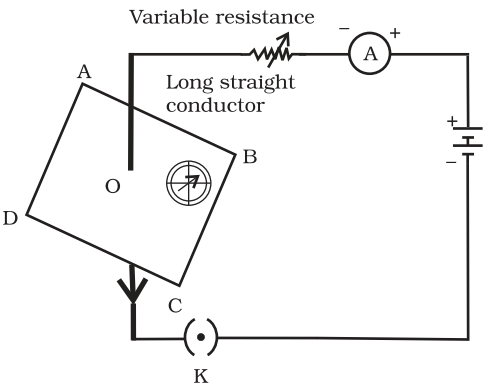
If the key in the arrangement $($Figure$)$ is taken out $($the circuit is made open$)$ and magnetic field lines are drawn over the horizontal plane $\text{ABCD},$ the lines are :
The main reason for the abundant coliform bacteria in the water of river Ganga is :
For a current in a long straight solenoid $N-$ and $S-$ poles are created at the two ends. Among the following statements, the incorrect statement is :
Which of the following statements is correct about an aqueous solution of an acid and of a base?
  1. Higher the $\ce{pH},$ stronger the acid.
  2. Higher the $\ce{pH},$ weaker the acid.
  3. Lower the $\ce{pH},$ stronger the base.
  4. Lower the $\ce{pH},$ weaker the base.
The elements $\ce{A, B, C, D}$ and $E$ have atomic numbers $9, 11, 17, 12$ and $13$ respectively. The pair of elements which belongs to the same group of the periodic table is: