Question
By using step-deviation method, compute the arithmetic mean for the following data:
Marks obtainedLess than 10Less than 20Less than 30Less than 40Less than 50Less than 60
Number of students142237586775

Answer

Self

Need a full question paper?

Generate a complete, print-ready paper with questions like this in minutes — across 16+ boards, with answer keys.

Start Generating Free

Similar questions

In quadrilateral ABCD; angles D = 90°, BC = 38 cm and DC = 25 cm. A circle is inscribed in this quadrilateral which touches AB at point Q such that QB = 27 cm, Find the radius of the circle.
Solve the following equation by factorization$\frac{x-3}{x+3}+\frac{x+3}{x-3}=2 \frac{1}{2}$
The marks of $10$ students of a class in an examination arranged in ascending order are as follows:
$13, 35, 43, 46, x, x + 4, 55, 61, 71, 80$
If the median marks is 48, find the value of x. Hence find the mode of the given data.
Draw a line segment OA , 5 cm long. AT O , using ruler and compasses only, construct OB such that , ∠ AOB = 37.5° construct a circle to touch OA at A and to touch OB at B.
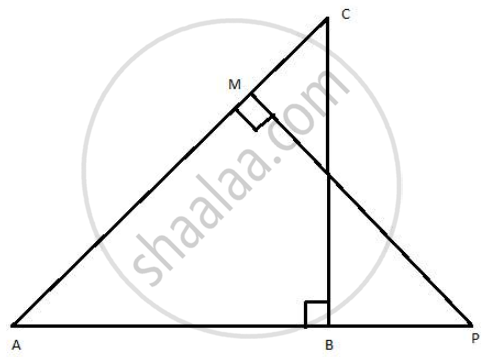
In the given figure,
$\triangle ABC$ and $\triangle AMP$ are right-angled at $B$ and $M$ respectively.
Given $AC = 10 cm, AP = 15 cm$ and $PM = 12\ cm.$
(i) Prove $\triangle ABC \sim \triangle AMP$
(ii) Find $AB$ and $BC$

In th following table, $Σf = 200$ and mean = $73$. find the missing frequencies $f_1$, and $f_2$.
 
x 0 50 100 150 200 250
f 46 $f_1$ $f_2​​​​​​​$ 25 10 5
Draw a line segment AB = 8 cm. Mark C, the mid-point of AB. Draw and describe the locus of a point which is
(a) 2 cm from AB (b) 4 cm from C. Mark the points E, F, G, H which satisfy both the above conditions.
(i) Describe the figure EFGH.
(ii) What kind of triangle is ECF?
If $a, b, c$ are in continued proportion and $a(b -c) = 2b$, prove that: $a-c=\frac{2(a+b)}{a}$
Construct a frequency polygon without using a histogram for the following frequency distribution :
Class Mark10152025303540
Frequency420404530255
Vivek invests ₹ $ 4,500$ in $8 \% $ ₹ $10$ shares at ₹ $ 15$. He sells the shares when the price rise to ₹ $ 30$, and invests the proceeds in $12 \%$ ₹ $100$ shares at ₹ $125$ . Calculate:
(i) the sale proceeds
(ii) the number of ₹ $125$ shares he buys
(iii) the change in his annual income from dividend.