Question
By using the rules of aromaticity, explain whether the following compounds are aromatic or non$-$aromatic.
$i.$ Benzene  $ii.$ Naphthalene  $iii.$ Cycloheptatriene
Answer

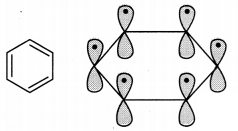
$i.$ Benzene:
$a.$ It is cyclic and planar.
$b.$ It has three double bonds and six $\pi$ electrons.
$c.$ It has a $p$ orbital on each carbon of the hexagonal ring. Hence, a continuous overlap above and below the ring is possible.
Image
$d.$ According to Huckcl rule, this compound is aromatic if, $4n + 2 =$ Number of $\pi$ electrons.
$4n + 2 = 6,$
$\therefore 4n = 6 – 2 = 4$
$n = 4/4 = 1,$ here, $‘n \ ’$ comes out to be an integer.
Hence, benzene is aromatic.
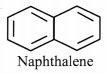
$ii.$ Naphthalene:
$a.$ It is cyclic and planar.
$b.$ It has $5$ double bonds and $10 n$ electrons.
Image
$c.$ It has a $p$ orbital on each carbon atom of the ring. Hence, a continuous overlap around the ring is possible.
$d.$ According to Huckel rule, this compound is aromatic if, $4n + 2 =$ Number of $\pi$ electrons.
$4n + 2 = 10,$
$\therefore 4n = 10 – 2 = 8$
$n = 8/4 = 2,$ Here $‘n’$ comes out to be an integer.
Hence, naphthalene is aromatic.
$iii.$ Cycloheptatriene:
$a.$ It is cyclic and planar.
$b.$ It has three double bonds and $6 \pi$ electrons.
Image
$c.$ But one of the carbon atoms is saturated $(sp^3$ hybridized$)$ and it does not have a $p$ orbital.
$d.$ Hence, a continuous overlap around the ring is not possible in cycloheptatriene. Hence, it is non$-$aromatic.

Need a full question paper?

Generate a complete, print-ready paper with questions like this in minutes — across 16+ boards, with answer keys.

Start Generating Free