Haloalkanes and Haloarenes — Chemistry STD 12 Science — Question
Rajasthan BoardEnglish MediumSTD 12 ScienceChemistryHaloalkanes and Haloarenes1 Mark
Question
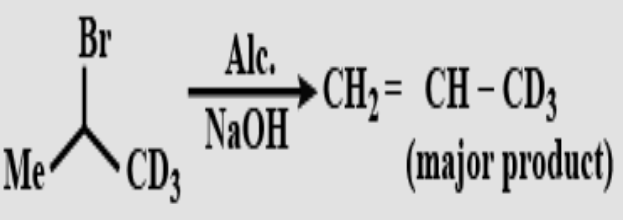
By which mechanism does the above reaction proceed?
✓
Answer
If the reaction proceeds by $E_1$ mechanism, then the breaking of $C−H$ and $C−D$ bonds is not involved in the slow step $($or rate determining effect$).$
Based on this both products $\ce{CH_2=CH−CD_3}$ and $\ce{CH_3−CH=CD_2}$ are expected.
However only $\ce{CH_2=CH−CD_3}$ is obtained. This indicates that breaking of $C−H$ bond.
$($which is faster than breaking of $C−D$ bond$)$ is involved in the mechanism along$-$with breaking of $C−Br$ bond.
This indicates $E_2$ mechanism for elimination.
Need a full question paper?
Generate a complete, print-ready paper with questions like this in minutes — across 16+ boards, with answer keys.