MCQ
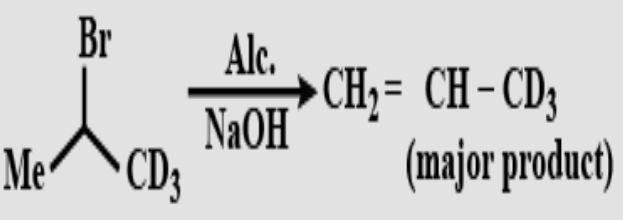
By which mechanism does the above reaction proceed?
- AE1
- BE2
- CE1cb
- D$\gamma$-Elimination
Explanation:
If the reaction proceeds by E1 mechanism, then the breaking of C−H and C−D bonds is not involved in the slow step (or rate determining effect). Based on this both products CH2=CH−CD3 and CH3−CH=CD2 are expected.
However only CH2=CH−CD3 is obtained. This indicates that breaking of C−H bond (which is faster than breaking of C−D bond) is involved in the mechanism along-with breaking of C−Br bond.
This indicates E2 mechanism for elimination.
Generate a complete, print-ready paper with questions like this in minutes — across 16+ boards, with answer keys.
For the cell $\mathrm{Cu}(\mathrm{s})\left|\mathrm{Cu}^{2+}(\mathrm{aq})(0.01 \mathrm{M}) \| \mathrm{Ag}^{+}(\mathrm{aq})(0.001 \mathrm{M})\right| \mathrm{Ag}(\mathrm{s})$ the cell potential $=.....\times 10^{-2} \mathrm{~V}$
(Round off to the Nearest Integer).
[Use: $\frac{2.303 \mathrm{RT}}{\mathrm{F}}=0.059$ ]