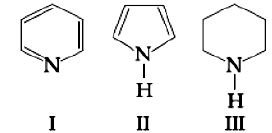
MCQ
$C + D$ The product $(C)$ and $(D)$ are
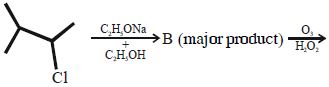
- AAcetone $+$ Ethanal
- ✓Acetone $+$ Ehtanoic acid
- CIsobutanal $+$ Methanal
- DIsobutanoic acid $+$ Methanoic acid
Generate a complete, print-ready paper with questions like this in minutes — across 16+ boards, with answer keys.
${O_3}(g)\, + \,C{l^ * }(g)\, \to \,{O_2}(g) + Cl{O^ * }(g)$ ..... $(i)$ $[{K_i} = 5.2 \times {10^9}\,\,L\,mo{l^{ - 1}}\,{s^{ - 1}}]$
$Cl{O^ * }(g) + {O^ * }(g)\, \to \,{O_2}(g) + \,C{l^ * }(g)$ ..... $(ii)$ $[{K_{ii}} = 2.6 \times {10^{10}}\,\,L\,mo{l^{ - 1}}\,{s^{ - 1}}]$
The closest rate constant for the overall reaction
${O_3}(g){\mkern 1mu} + {\mkern 1mu} {O^*}(g){\mkern 1mu} \to {\mkern 1mu} 2{O_2}(g)$ is ........... $L\,\,mo{l^{ - 1}}\,{s^{ - 1}}$
Product is :-
$E^o_{Cr^{3+}/Cr} =-0.74\, V,\,$ $E^o_{MnO_4^-/Mn^{2+}} =1.51 \,V$
$E^o_{Cr_2O_7^{2-}/Cr^3+} =1.33\,V:$ $E^o_{Cl/Cl^-} =1.36\,V$
Based on the data given above, strongest oxidising agent will be :