MCQ
${C_6}{H_5}CONHC{H_3}$ can be converted into ${C_6}{H_5}C{H_2}NHC{H_3}$ by
  • A
    $NaB{H_4}$
  • B
    ${H_2} - Pd/C$
  • C
    $LiAl{H_4}$
  • $Zn - Hg/HCl$

Answer

Correct option: D.
$Zn - Hg/HCl$
d
${C_6}{H_5}CONHC{H_3} \,\mathop {\xrightarrow{{Zn - Hg/}}}\limits_{HCl} \,{C_6}{H_5}C{H_2}NHC{H_3}$

This reaction is known as Clemmenson reduction.

Need a full question paper?

Generate a complete, print-ready paper with questions like this in minutes — across 16+ boards, with answer keys.
Start Generating Free

Similar questions

One faraday of electricity will liberate one gram mole of the metal from the solution of:
Cannizzaro reaction is not shown by
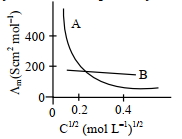
The molar conductivity for electrolytes $A$ and $B$ are plotted against $C^{1 / 2}$ as shown below. Electrolytes $A$ and $B$ respectively are:
The three elements $X, Y$ and $Z$ with electronic configurations shown below all form hydrides

Element Electronic configuration
$X$ $1s^2\,2s^2\,2p^2$
$Y$ $1s^2\,2s^2\,2p^6\,3s^1$
$Z$ $1s^2\,2s^2\,2p^6\,3s^2\,3p^6\,3d^{10}\,4s^2\,4p^5$

Which set of properties match correctly with properties of the hydrides of these elements

$\mathop {{C_6}{H_6}O}\limits_{phenol} $ $\xrightarrow[\begin{subarray}{l} 
  3{H_2}(High\,\,temp \\ 
  and\,\,pressure) 
\end{subarray} ]{{Ni}}(A)\xrightarrow{{Cu}}(B)$ $\xrightarrow{{N{H_2}OH}}(C)\xrightarrow{{{H^ \oplus }}}$ $(D)\xrightarrow{{H{O^ - }}}(E)$

Product $(E) $ is

A trisubstituted compound ' $A$ ', $C _{10} H _{12} O _2$ gives neutral $FeCl _3$ test positive. Treatment of compound ' $A$ ' with $NaOH$ and $CH _3 Br$ gives $C _{11} H _{14} O _2$, with hydroiodic acid gives methyl iodide and with hot conc. $NaOH$ gives a compound B, $C _{10} H _{12} O _2$. Compound 'A' also decolorises alkaline $KMnO _4$. The number of $\pi$ bond/s present in the compound ' $A$ ' is $...........$
$2\,m$ aqueous solution of an electrolyte $x_3y_2$ is $25\%$ ionized. The boiling point of the solution is .......... $K.$   ( $K_b$ for $H_2O = 0.52\,K\,kg/mol$ )
In which of the following molecules carbon atom marked with asterisk (*) is asymmetric?

The higer oxidation states of transition elements are found to be in the combination with $A$ and $B$ which are
$C{H_3}MgI$ is an organometallic compound due to