MCQ
${C_6}{H_6} + C{H_3}Cl\mathop {\xrightarrow{{{\text{anhydrous}}}}}\limits_{AlC{l_3}} {C_6}{H_5}C{H_3} + HCl$ is an example of
- ✓Friedel-Craft's reaction
- BKolbe's synthesis
- CWurtz reaction
- DGrignard reaction
Generate a complete, print-ready paper with questions like this in minutes — across 16+ boards, with answer keys.
The half-life period is independent of the concentration of zinc at constant $pH$. For the constant concentration of $Zn$, the rate becomes $100$ times when $pH$ is decreased from $3\, to\, 2$. Identify the correct statements $(pH = -\log [H^{+}])$
$(A)$ $\frac{{dx}}{{dt}}\, = k{[Zn]^0}{[{H^ + }]^2}$
$(B)$ $\frac{{dx}}{{dt}}\, = k{[Zn]}{[{H^ + }]^2}$
$(C)$ Rate is not affected if the concentraton of zinc is made four times and that of $H^+$ ion is halved.
$(D)$ Rate becomes four times if the concentration of $H^+$ ion is doubled at constant $Zn$ concentration
$A$. $T _4 > T _3 > T _2 > T _1$
$B.$ The black body consists of particles performing simple harmonic motion.
$C.$ The peak of the spectrum shifts to shorter wavelength as temperature increases.
$D.$ $\frac{ T _1}{ v _1}=\frac{ T _2}{ v _2}=\frac{ T _3}{ v _3} \neq$ constant
$E.$ The given spectrum could be explained using quantisation of energy.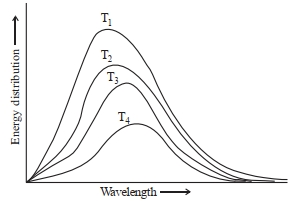
How can this reaction is made to proceed in forward direction?