Question
Calculate Current Ratio from the following information:
Particulars
Particulars
Total Assets.
5,00,000
Non-Current Liabilities.
1,30,000
Fixed Tangible Assets.
2,50,000
Non-Current Investments
1,50,000
Shareholders' Funds.
3,20,000


Answer

Total Assets = Fixed Tangible Assets + Non - Current Investments + Current Assets
5,00,000 = 2,50,000 + 1,50,000 + Current Assets Current Assets
= 5,00,000 - 4,00,000 = ₹ 1,00,000
Total Assets = Shareholder’s Funds + Non - Current Liabilities + Current Liabilities
5,00,000 = 3,20,000 + 1,30,000 + Current Liabilities
Current Liabilities = 5,00,000 - 4,50,000 = ₹ 50,000
$\text{Current Ratio}=\frac{\text{Current Assets}}{\text{Current Liabilities}}$
$=\frac{1,00,000}{50,000}=2:1$

Need a full question paper?

Generate a complete, print-ready paper with questions like this in minutes — across 16+ boards, with answer keys.

Start Generating Free

Similar questions

Compute Stock Turnover Ratio from the following information:
Net Revenue from Operations
₹ 2,00,000
Gross Profit
₹ 50,000
Inventory at the end
₹ 60,000
Excess of inventory at the end over inventory in the beginning
₹ 20,000
Calculate Cost Of Revenue From Oprations from the following information:
Revenue from Operation ₹ 12,00,000; Oprating Ratio 75% Operating Expenses ₹ 1,00,000.
Taneja Constructions Ltd. has an outstanding balance of ₹ 5,00,000, 7% debentures of ₹ 100 each redeemable at a premium of 10%. According to the terms of redemption, the company redeemed 30% of the above debentures by converting them into shares of ₹ 50 each at a premium of 20%. Record the entries for redemption of debentures in the books of Taneja Constructions Ltd.
Working Capital ₹ 5,40,000 Current Ratio 2.8 : 1 Inventory ₹ 3,30,000. Calculate Current Assets, Current Liabilities and Quick Ratio.
Z Ltd. had issued following debentures:
  1. 1,00,000, 10% fully convertible debentures of ₹ 100 each on 1st April, 2016 redeemable by conversion after 5 years.
  2. 20,000, 10% Debentures of ₹ 100 each redeemable after 4 years, 25% Debentures in Cash and 75% by conversion.
State the amount of DRR required to be created as per the Companies Act, 2013.
X Ltd. invited application for 10,000 Equity Shares of ₹ 10 each issued at par. The amount was payable on application. The issue was oversubscribed by 2,000 shares and allotment was made on pro rata basis. Pass necessary Journal entries.
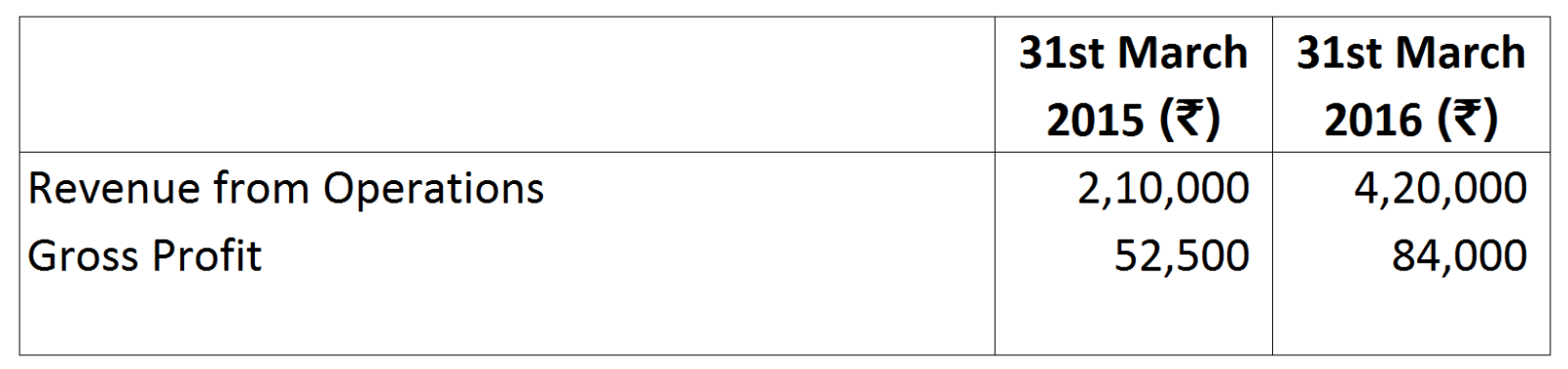
The following figures have been taken from the published accounts of G. Associates for the two successive years:
Comment upon the profitability for the two years.
On the basis of the following information, calculate Total Assets to Debt Ratio:
Particulars
Particulars
Capital Employed.
50,00,000
Share Capital.
35,00,000
Current Liabilities.
20,00,000
10% Debentures.
10,00,000
Land and Building.
60,00,000
General Reserve.
3,00,000
Trade Receivable.
4,00,000
Surplus, i.e., Balance in.
2,00,000
Cash and Cash.
5,00,000
Statement of.
 
Equivalents.
1,00,000
Profit and Loss.
 
[Hint: Long-term Debts = Capital Employed - Shareholders' Funds.]
Current Assets ₹ 5,00,000; Working Capital ₹ 3,00,000. Calculate Current Ratio.
Illustrate the method of determining trade receivables turnover ratio What does it indicate?