Question
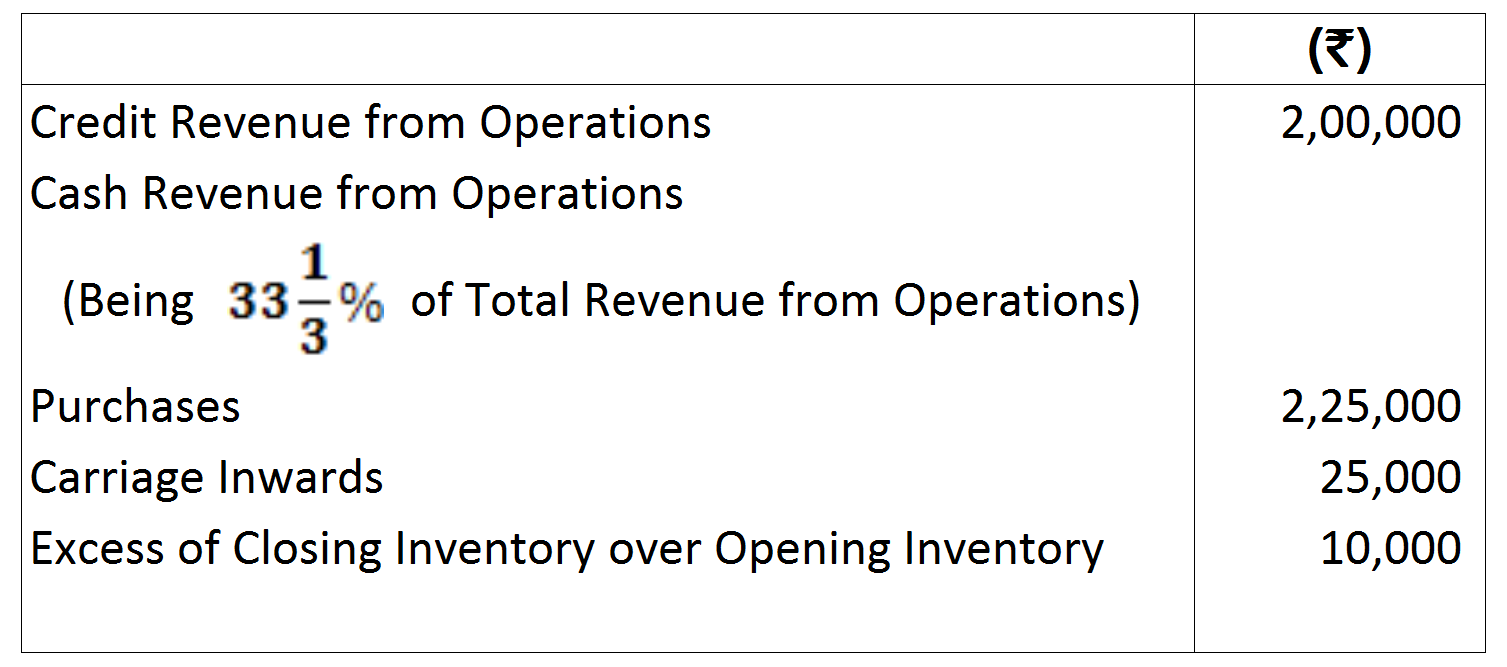
Calculate Gross Profit Ratio from the following data:
Answer

If Total Revenue from Operations is ₹ 100, Cash Revenue from Operations will be $₹\ 33 \frac{1}{3}$ and Credit Revenue from Operations $₹\ 66 \frac{2}{3}$
Hence,
If Credit Revenue from Operations is $₹\ 66 \frac{2}{3}$ Total Revenue from Operations will be= ₹ 100
If Credit Revenue from Operations is ₹ 2,00,000
Total Revenue from Operations will be $=\frac{100}{66\frac{2}{3}}\times ₹\ 2,00,000$
$=100\times\frac{2}{200}\times ₹\ 2,00,000$
$=₹\ 3,00,000$
Cost of Revenue from Operations = Purchases + Carriage Inwards - Excess of Closing Inventory over Opening Inventory
= ₹ 2,25,000 + ₹ 25,000 - ₹ 10,000
= ₹ 2,40,000
Gross Profit = Total Revenue from Operations - Cost of Revenue from Operations
= ₹ 3,00,000 - ₹ 2,40,000 = ₹ 60,000
Gross Profit Ratio $=\frac{\text{Gross Profit}}{\text{Net Revenue from Operations x}}\times100$
$=\frac{₹\ 60,000}{₹\ 3,00,000}\times100= 20 \%$

Need a full question paper?

Generate a complete, print-ready paper with questions like this in minutes — across 16+ boards, with answer keys.

Start Generating Free

Similar questions

Balance Sheet had the following amounts as at 31st March, 2018:
 
10% Preference Share Capital. 5,00,000
Equity Share Capital. 15,00,000
Securities Premium Reserve. 1,00,000
Reserves and Surplus. 4,00,000
Long-term Loan from IDBI @ 9%. 30,00,000
Current Asset. 12,00,000
Current Liabilities. 8,00,000
(Investments in other companies). 2,00,000
Fixed Assets-Cost. 60,00,000
Depreciation Written off. 14,00,000
Calculate ratios indicating the Long-term and the Short-term financial position of the company.
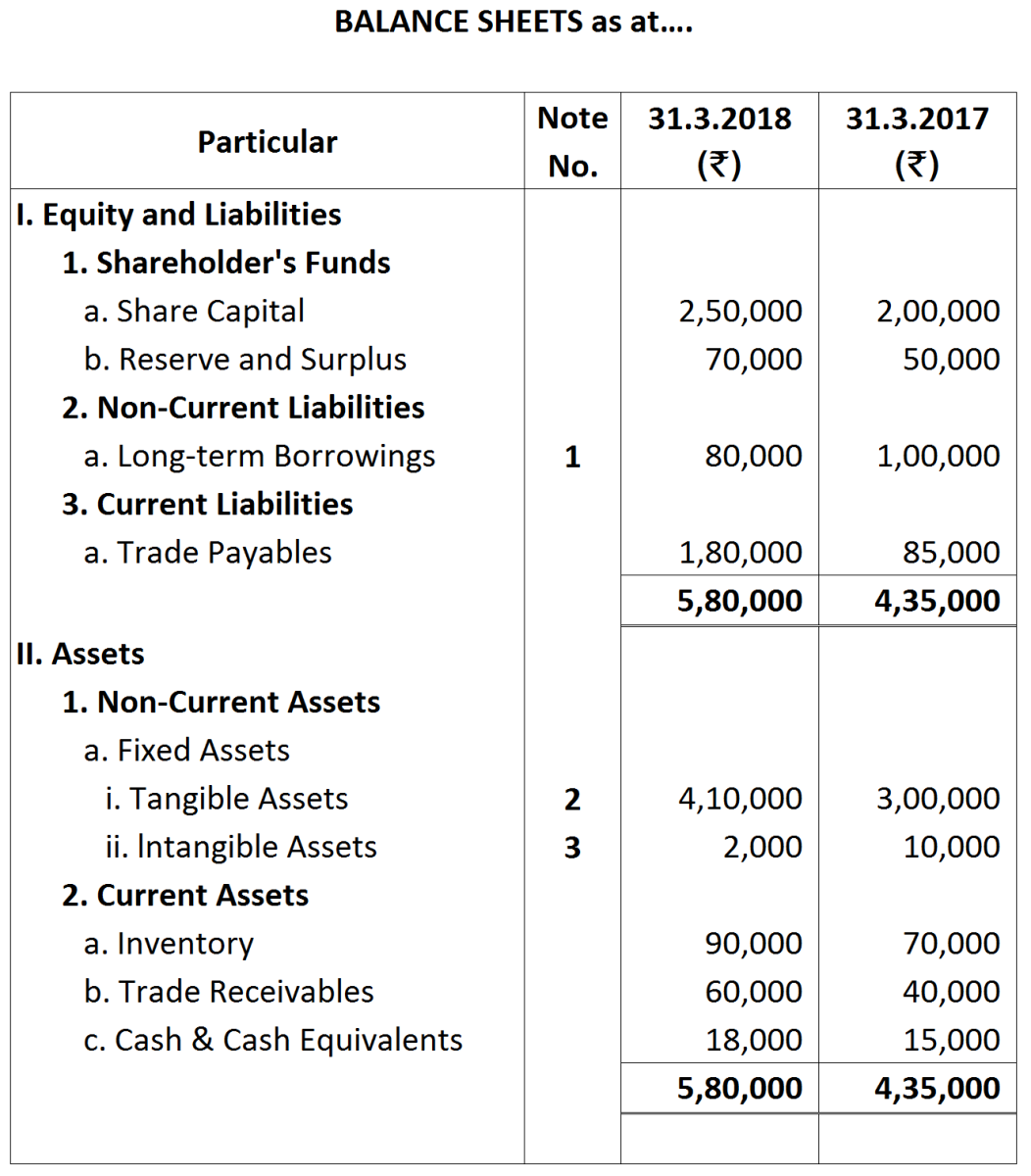
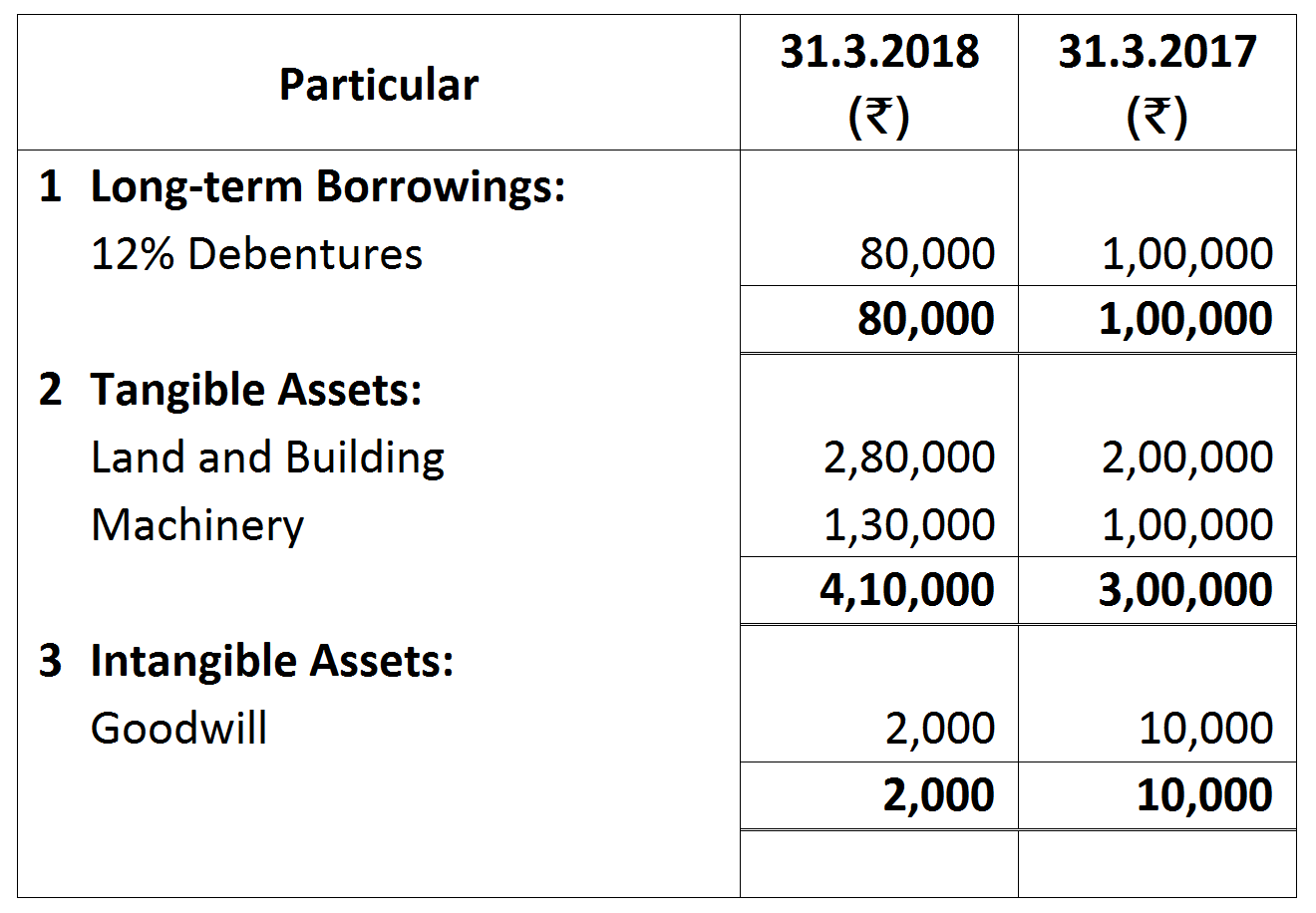
Prepare a Cash Flow Statement on the basis of the information given in the Balance Sheets of P.S. Ltd. as at 31st March 2018 and 2017:
Notes:

Debentures amounting to ₹ 20,000 were redeemed on 31st Dec., 2017. Interest on debentures has been paid regularly.
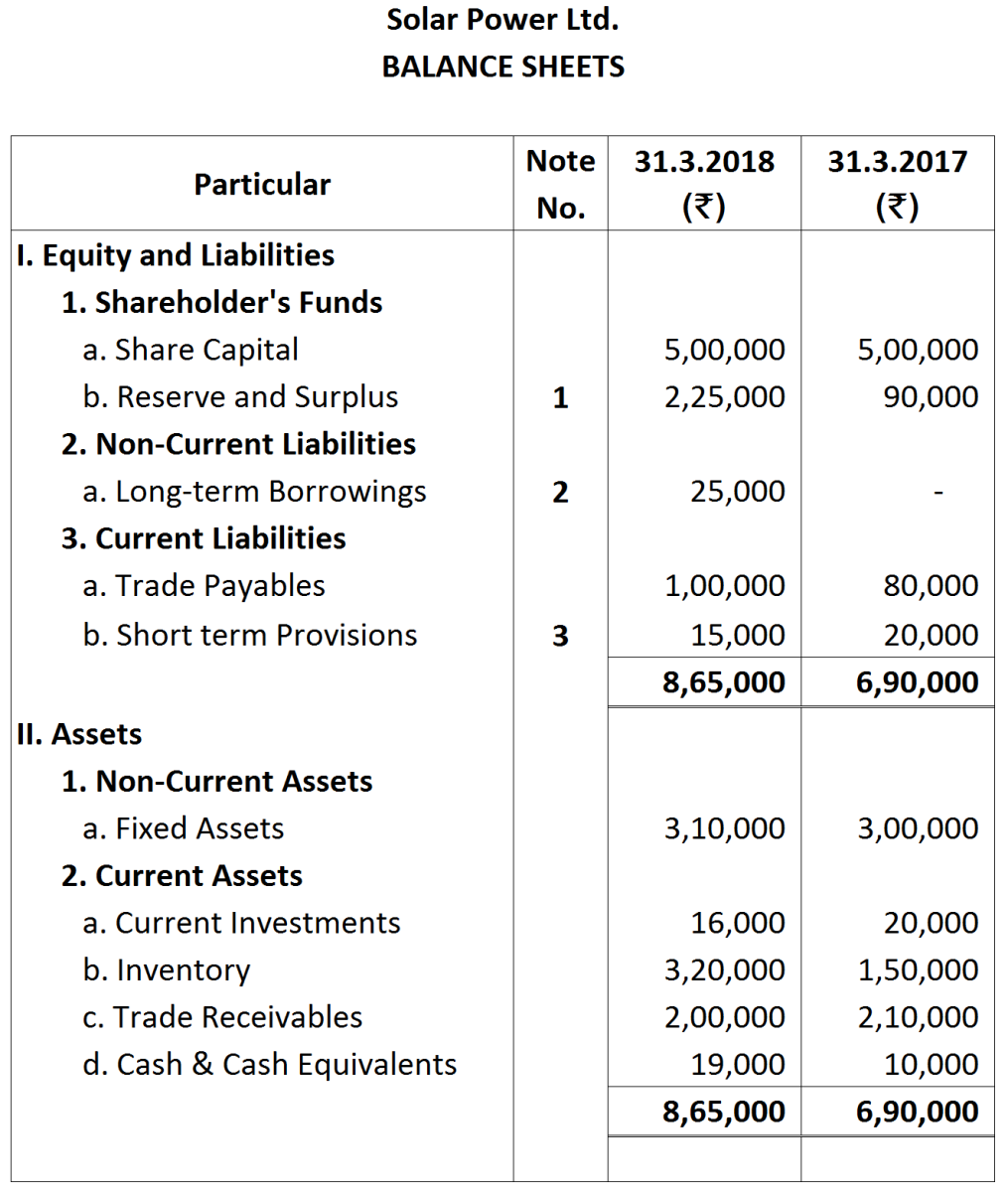
Prepare a Cash-Flow Statement from the Balance Sheets given below:
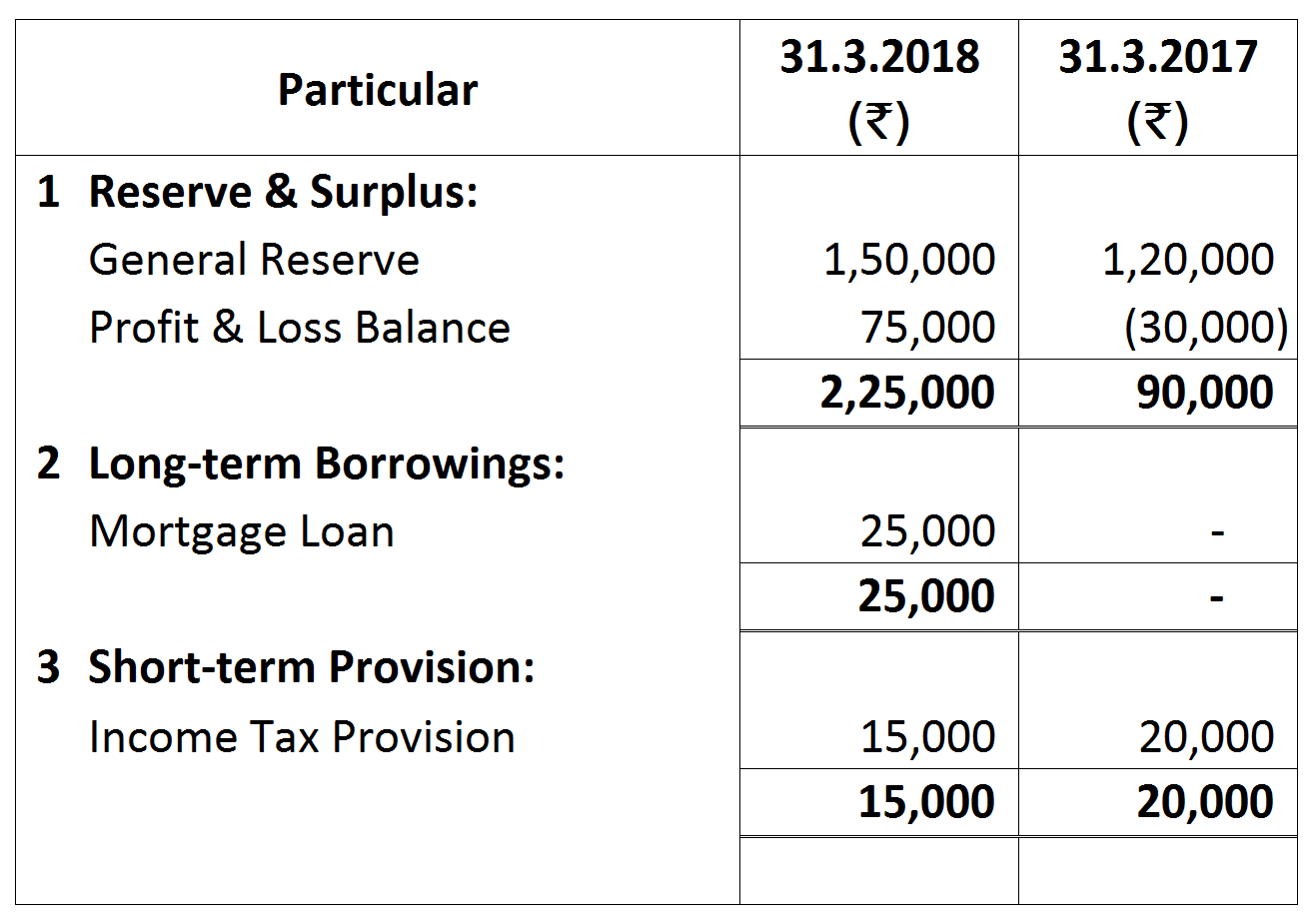
Notes:

Additional Information:
  1. Depreciation written off on fixed assets @ 10% on last year's balance.
  2. Interim Dividend paid during the year @ 10% on Share Capital.
  3. Mortgage Loan was taken on 1st July 2017 @ 10% p.a. Interest has been paid up-to date.
Under which heads will the following items be shown in the Balance Sheet of a company:
  1. Bank Balance.
  2. Investments (Long-term).
  3. Outstanding Salary.
  4. Authorised Capital.
  5. Bills Payable.
  6. Unclaimed Dividends.
  7. Shares Option Outstanding Account.
  8. General Reserve.
  9. Subsidy Reserve?
X Ltd. issued 80,00,000, 8% debentures of ₹ 100 each on 1st April, 2007. The terms of issue stated that the debentures were to be redeemed at a premium of 5% on 30th June, 2015. The company decided to transfer out of profits ₹ 10,00,000 to Debenture Redemption Reserve on 31st March, 2014 and ₹ 10,00,000 on 31st March, 2015.
Pass the necessary Journal entries regarding the issue and redemption of debentures, without providing for either the interest or loss on issue of debentures.
Kishna Ltd issued 15,000 shares of ₹ 100 each at a premium of ₹ 10 per share, payable as follows:
On application
₹ 30
On allotment
₹ 50 [including premium]
On first and final call
₹ 30
All the shares subscribed and the company received all the money due, With the exception of the allotment and call money on 150 shares. These shares were forfeited and reissued to Neha as fully paid share of ₹ 12 each.
Give journal entries in the books of the company.
Prepare Balance Sheet of VT Ltd. as at 31st March, 2018, from the following information as per Schedule III, Part I of the Companies Act, 2013:
Calculate current assets of a company from the following information:
  1. Inventory turnover 4 times.
  2. Inventory in the end is ₹ 20,000 more than inventory in the beginning.
  3. Revenue from Operations ₹ 3,00,000.
  4. Gross profit ratio 20%.
  5. Current liabilities ₹ 40,000.
  6. Quick ratio 0.75.
The Current Ratio of a Company is 3 : 1. State giving reasons which of the following suggestions would (i) Improve; (ii) Reduce; (iii) Not change; the Current Ratio:-
  1. Payment of Trade Payables.
  2. Sale of goods costing ₹ 20,000 for ₹ 20,000 for Cash.
  3. Sale of goods costing ₹ 20,000 for ₹ 18,000 on Credit.
  4. Sale of goods costing ₹ 20,000 at a profit of ₹ 1,000.
  5. Purchase of goods on Credit.
  6. Purchase of goods for Cash.
  7. Purchase of machinery against long-term loan.
With the help of the given information, calculate any three of the following ratios:
  1. Operating ratio.
  2. Quick ratio.
  3. Working capital turnover ratio.
  4. Debt equity ratio.
Information: Equity Share Capital ₹ 50,000; 12% Preference Share Capital ₹ 40,000; 12% Debentures ₹ 30,000; General Reserve ₹ 40,000; Revenue from Operations ₹ 3,00,000; Opening Inventory ₹ 20,000; Purchases ₹ 1,40,000; Wages ₹ 30,000; Closing Inventory ₹ 40,000; Selling and distribution expenses ₹ 18,000; Other Current Assets ₹ 1,00,000 and Current Liabilities ₹ 60,000.