Question
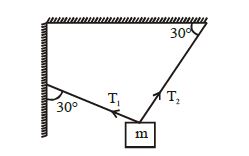
Calculate $T_1$ and $T_2$
Answer

$\frac{\mathrm{T}_{1}}{\sin 120^{\circ}}=\frac{\mathrm{Mg}}{\sin 90^{\circ}}$

$\mathrm{T}_{1}=\frac{\sqrt{3}}{2} \mathrm{Mg}$

$\frac{\mathrm{T}_{2}}{\sin 150^{\circ}}=\frac{\mathrm{Mg}}{\sin 90^{\circ}}$

$\mathrm{T}_{2}=\frac{\mathrm{Mg}}{2}$

Need a full question paper?

Generate a complete, print-ready paper with questions like this in minutes — across 16+ boards, with answer keys.

Start Generating Free

Similar questions

A disc of radius $2\; \mathrm{m}$ and mass $100\; \mathrm{kg}$ rolls on a horizontal floor. Its centre of mass has speed of $20\; \mathrm{cm} / \mathrm{s} .$ How much work is needed to stop it?
Excess pressure inside a soap bubble is three times that of the other bubble, then the ratio of their volumes will be
Assertion : Two equipotential surfaces cannot cut each other.

Reason : Two equipotential surfaces are parallel to each other.
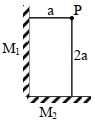
Two plane mirrors ${M}_{1}$ and ${M}_{2}$ are at right angle to each other shown. A point source $'P'$ is placed at $'a'$ and $'2a'$ meter away from ${M}_{1}$ and ${M}_{2}$ respectively. The longest distance between the images thus formed is : (Take $\sqrt{5}=2.3$ )
An electron having mass $m$ and kinetic energy $K$ enter in uniform magnetic field $B$ perpendicularly, then its frequency will be
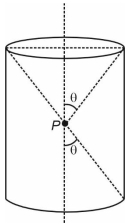
A charge is kept at the central point $P$ of a cylindrical region. The two edges subtend a half-angle $\theta$ at $P$, as shown in the figure. When $\theta=30^{\circ}$, then the electric flux through the curved surface of the cylinder is $\Phi$ If $\theta=60^{\circ}$, then the electric flux through the curved surface becomes $\Phi / \sqrt{n}$, where the value of $n$ is. . . . . . .
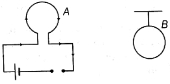
A system $S$ consists of two coils $A$ and $B$. The coil $A$ carries a steady current $I .$ While the coil $B$ is suspended nearby as shown in figure. Now, if the system is heated, so as to raise the temperature of two coils steadily, then
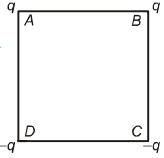
Charges are placed on the vertices of a square as shown Let $\vec E$ be the electric field and $V$ the potential at the centre. If the charges on $A$ and $B$ are interchanged with those on $D$ and $C$ respectively, then
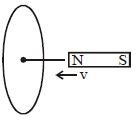
In the given figure, the magnet is moved towards the coil with speed $'v'$ and induced  $emf$ is $'e'$. If magnet and coil recede away from one another each moving with speed $'v'$, the induced $emf$ in the coil will be
At room temperature $\left(27^{\circ} \mathrm{C}\right)$, the resistance of a heating element is $50 \Omega$. The temperature coefficient of the material is $2.4 \times 10^{-4}{ }^{\circ} \mathrm{C}^1$. The temperature of the element, when its resistance is $62 \Omega$, is $\qquad$ ${ }^{\circ} \mathrm{C}$.