Question
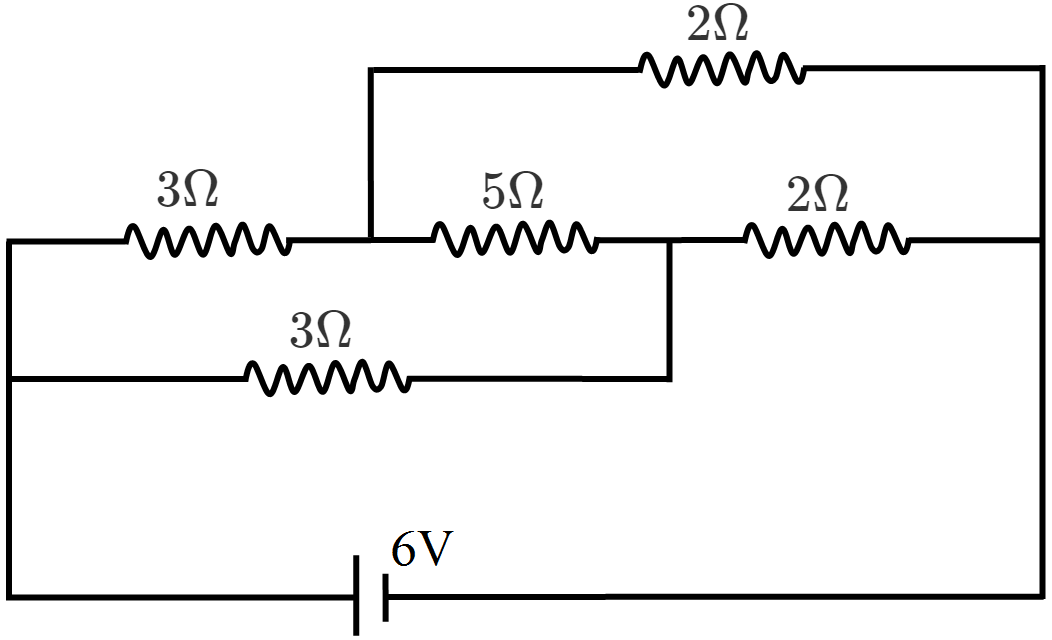
Calculate the current drawn from the battery in the given network shown here. State Kirchhoff’s loop law and name the law on which it is based.
Answer

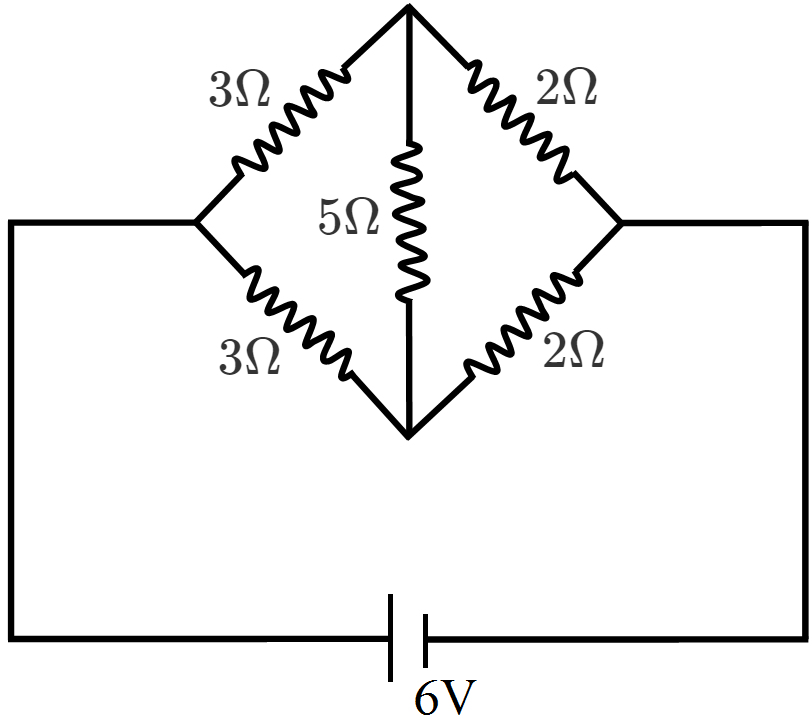
The equivalent circuit is as shown in figure alongside.

[$\therefore$ Bridge is in balanced condition, no current flows through $5\Omega$ resistance]

$\frac{1}{\text{R}}=\frac{1}{5}+\frac15\text{R}=5\Omega$

Current in the circuit $=\frac{6}{2.5}\text{A}=2.4\text{A}$

Kirchhoff’s Loop Law: The algebraic sum of potential differences of different circuit elements of a closed circuit (or mesh) is zero. This law is based on law of conservation of energy.

Need a full question paper?

Generate a complete, print-ready paper with questions like this in minutes — across 16+ boards, with answer keys.

Start Generating Free

Similar questions

The conductivity of a pure semiconductor is roughly proportional to $\text{T}^\frac{3}{2}\text{e}^{\frac{-\Delta\text{E}}{2\text{kT}}}$ where $\Delta\text{E}$ is the band gap. The band gap for germanium is 0.74eV at 4K and 0.67eV at 300K. By what factor does the conductivity of pure germanium increase as the temperature is raised from 4K to 300K?
What should be the distance between the object in Exercise 9.30 and the magnifying glass if the virtual image of each square in the figure is to have an area of 6.25 mm2. Would you be able to see the squares distinctly with your eyes very close to the magnifier?
Two particles, carrying charges -q and +q and having equal masses m each, are fixed at the ends of a light rod of length a to form a dipole. The rod is clamped at an end and is placed in a uniform electric field E with the axis of the dipole along the electric field. The rod is slightly tilted and then released. Neglecting gravity find the time period of small oscillations.
A convex lens produces a double size real image when an object is placed at a distance of 18cm from it. Where should the object be placed to produce a triple size real image?
A particle goes in a circle of radius 2.0cm. A concave mirror of focal length 20cm is placed with its principal axis passing through the centre of the circle and perpendicular to its plane. The distance between the pole of the mirror and the centre of the circle is 30cm. Calculate the radius of the circle formed by the image.
By what fraction does the mass of a boy increase when he starts running at a speed of 12km/h?
Explain use of juction diode as full wave rectifier.
Suppose the rod in the previous problem has a mass of 1kg distributed uniformly over its length:
  1. Find the initial angular acceleration of the rod.
  2. Find the tension in the supports to the blocks of mass 2kg and 5kg.
A charge Q is uniformly distributed over a rod of length l. Consider a hypothetical cube of edge l with the centre of the cube at one end of the rod. Find the minimum possible flux of the electric field through the entire surface of the cube.
The product of the hole concentration and the conduction electron concentration turns out to be independent of the amount of any impurity doped. The concentration of conduction electrons in germanium is 6 × 1019 per cubic metre. When some phosphorus impurity is doped into a germanium sample, the concentration of conduction electrons increases to 2 × 10²³ per cubic metre. Find the concentration of the holes in the doped germanium.