Question
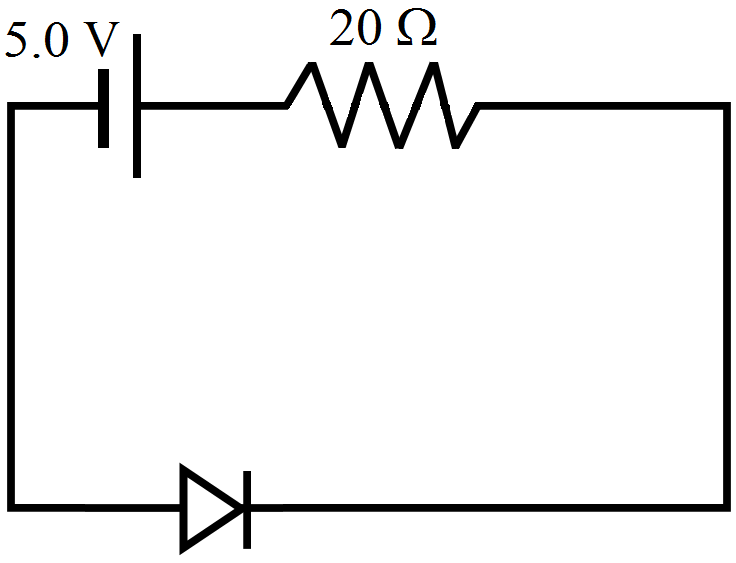
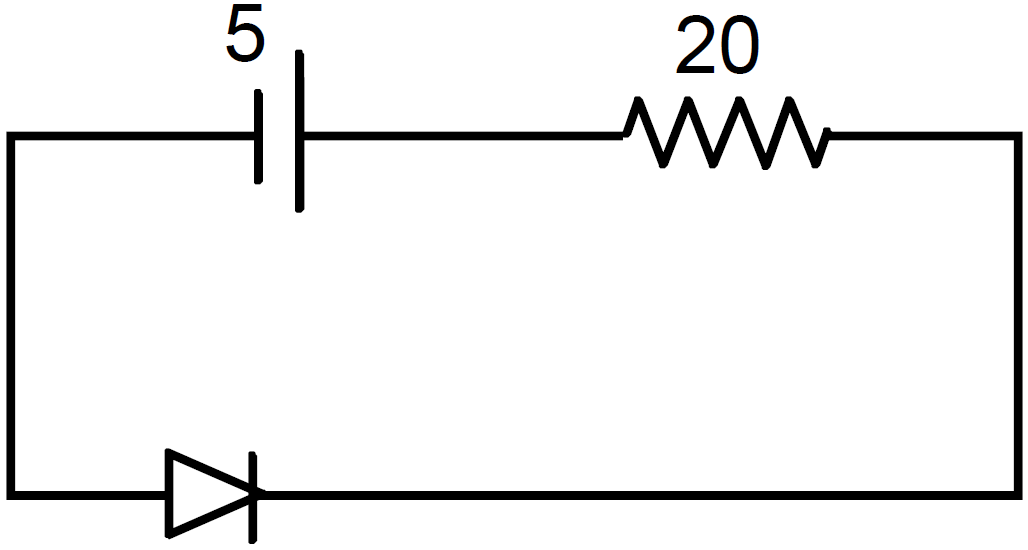
Calculate the current through the circuit and the potential difference across the diode shown in figure. The drift current for the diode is $20\mu\text{A}.$
Answer


Current in the circuit = Drift current
(Since, the diode is reverse biased $=20\mu\text{A})$
Voltage across the diode $=5-\big(20\times20\times10^{-6}\big)$
$=5-\big(4\times10^{-4}\big)=5\text{V}.$

Need a full question paper?

Generate a complete, print-ready paper with questions like this in minutes — across 16+ boards, with answer keys.
Start Generating Free

Similar questions

Illustrate by drawing the helical motion of a charged particle in a uniform magnetic field and derive the equations of pitch and radius of helix. $\#\#\#$ Discuss the path of motion of a charged particle entering with velocity at angle $\theta$ with uniform magnetic field. $($where $\theta \neq 0, \frac{\pi}{2}, \pi )$
Compare the direction of the magnetic field inside a solenoid with that of the field there if the solenoid is replaced by its equivalent combination of north pole and south pole.
Give explanation of linearly pofarized, unpolarized and plane polarized wave.
Derive the equation of average power for $\text{L - C - R}$ series $AC$ circuit.
Calculate the mass of $1\ cm^3$ of oxygen kept at $\text{STP}.$
A parallel beam of monochromatic light of wavelength $663\ nm$ is incident on a totally reflecting plane mirror. The angle of incidence is $60^\circ$ and the number of photons striking the mirror per second is $1.0 \times 10^{19}.$ Calculate the force exerted by the light beam on the mirror.
Two bar magnets are placed close to each other with their opposite poles facing each other. In absence of other force the magnets are pulled towards each other and their kinetic energy increases. Does it contradict our earher knowledge that magnetic forces cannot do any work and hence cannot increase kinetic energy of a system?
Why does a phonograph-record attract dust particles just after it is cleaned?
In the given figure, a current carrying conductor of non-uniform cross-section is shown. At what points, the magnitude will be maximum of (i) current (ii) current density and (iii) drift velocity?
Image
What is point electric charge?