Question
  1. Calculate the equivalent resistance of the given electrical network between points A and B.
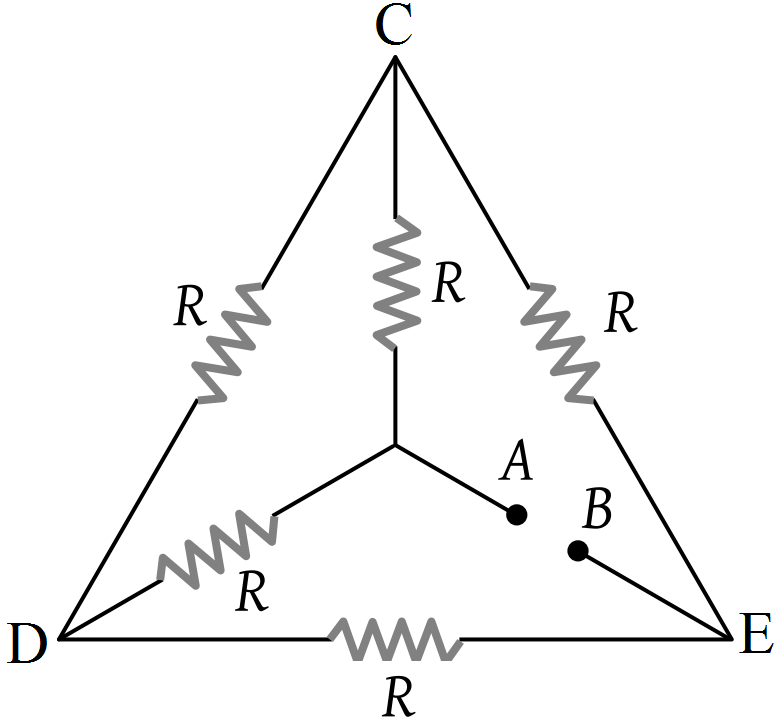
  1. Also calculate the current through CD and ACB if a 10V dc source is connected between points A and B and the value of $\text{R}=2\Omega.$
Answer


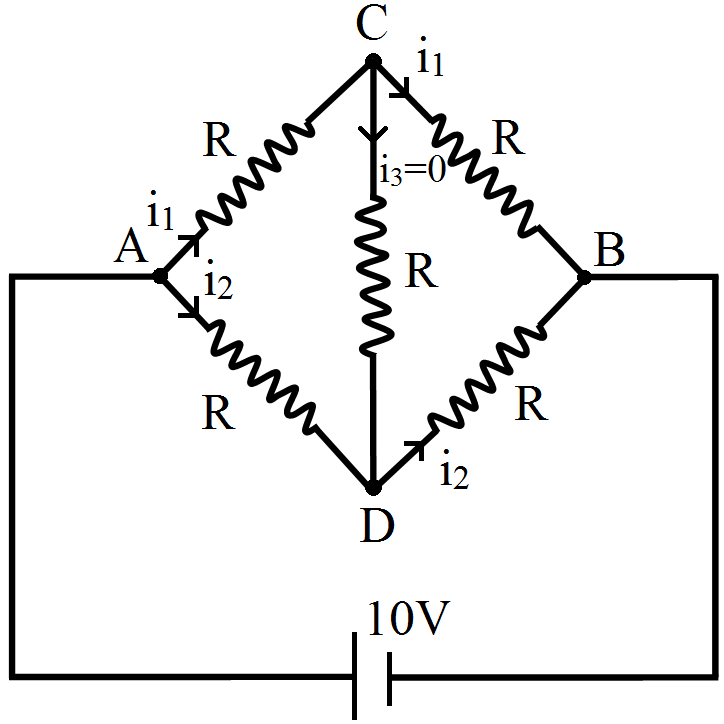
  1. The equivalent circuit is shown in fig. It is a balanced Wheatstone bridge.
So, the resistance connected between C and D is ineffective.
Resistance of arm ACB, $R_1 = R + R = 2R$
Resistance of arm ADB, $R_2 = R + R = 2R$
Equivalent resistance between A and B, RAB is given by
$\frac{1}{\text{R}_\text{AB}}=\frac{1}{2\text{R}}+\frac{1}{2\text{R}}=\frac{2}{2\text{R}}$
$\Rightarrow\text{R}_\text{AB}=\text{R}=2\Omega$
  1. In arm CD, there is no current, ICD = 0,
Current through arm ACB
$\text{i}_1=\frac{\text{V}}{\text{R}_1}$
$=\frac{10}{2\text{R}}=\frac{10}{2\times2}=\frac{10}{4}=2.5\text{A}$

Need a full question paper?

Generate a complete, print-ready paper with questions like this in minutes — across 16+ boards, with answer keys.
Start Generating Free

Similar questions

A mica strip and a polysterene strip are fitted on the two slits of a double slit apparatus. The thickness of the strips is 0.50mm and the separation between the slits is 0.12cm. The refractive index of mica and polysterene are 1.58 and 1.55 respectively for the light of wavelength 590nm which is used in the experiment. The interference is observed on a screen a distance one meter away.
  1. What would be the fringe-width?
  2. At what distance from the centre will the first maximum be located?
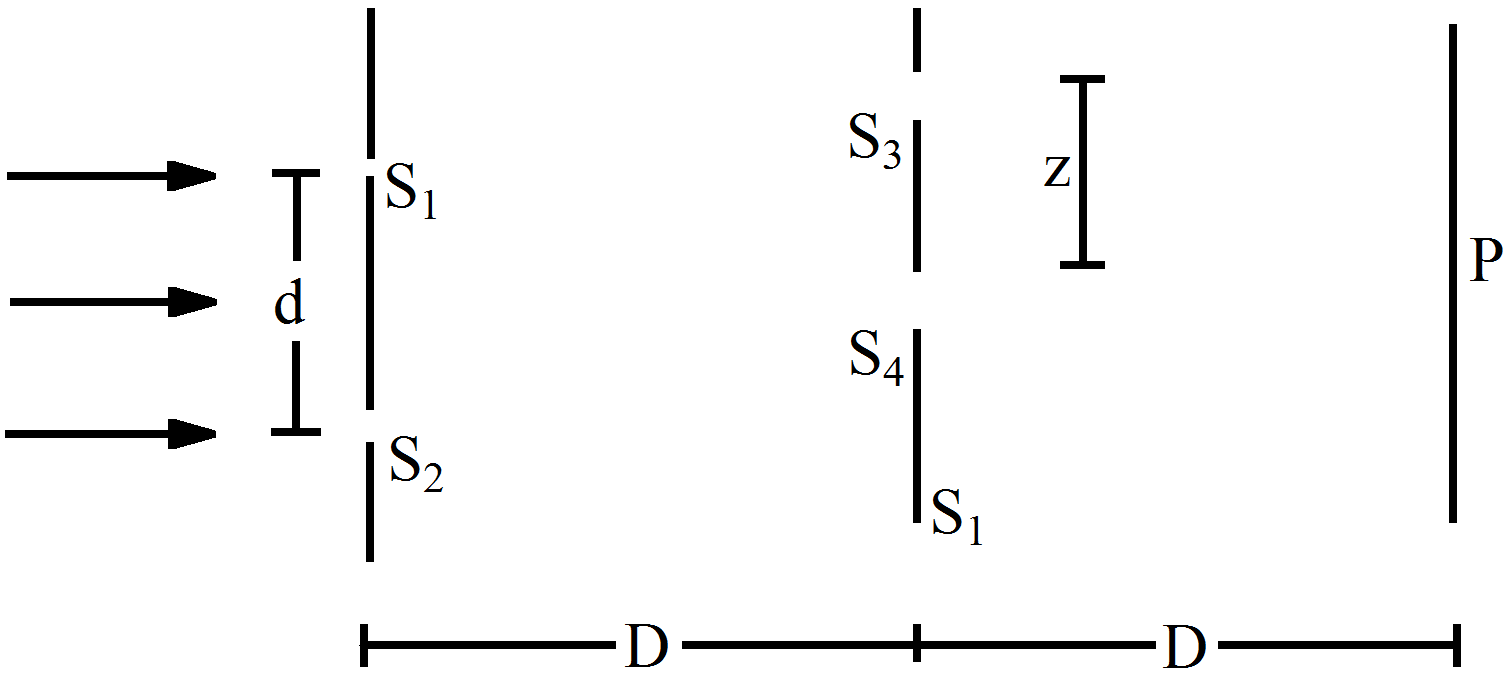
Consider the arrangement shown in figure. By some mechanism, the separation between the slits $S_3$ and $S_4$ can be changed. The intensity is measured at the point P which is at the common perpendicular bisector

of $S_1S_2$ and $S_3S_4.$ When $\text{z}=\frac{\text{D}\lambda}{2\text{d}},$ intensity measured at P is I. Find this intensity when z is equal to:
  1. $\frac{\text{D}\lambda}{\text{d}}$
  2. $\frac{3\text{D}\lambda}{2\text{d}}$
  3. $\frac{2\text{D}\lambda}{\text{d}}$
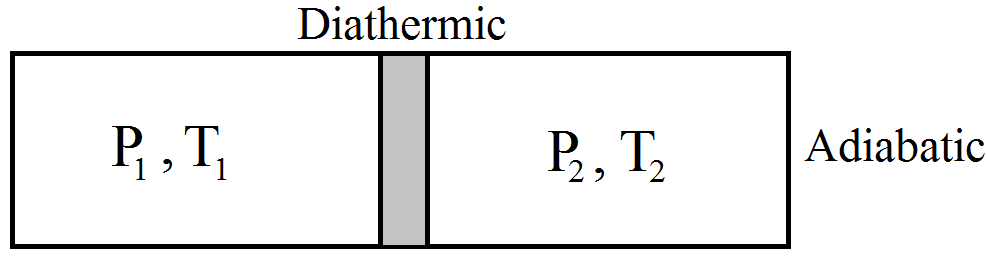
Figure. shows a cylindrical tube of volume V with adiabatic walls containing an ideal gas. The internal energy of this ideal gas is given by 1.5nRT. The tube is divided into two equal parts by a fixed diathermic wall. Initially, the pressure and the temperature are $P_1, T_1$ on the left and $p_2, T_2$ on the right. The system is left for sufficient time so that the temperature becomes equal on the two sides.
  1. How much work has been done by the gas on the left part?
  2. Find the final pressures on the two sides.
  3. Find the final equilibrium temperature.
  4. How much heat has flown from the gas on the right to the gas on theleft?
Hydrogen gas is contained in a closed vessel at 1atm (100kPa) and 300K. (a) Calculate the mean speed of the molecules. (b) Suppose the molecules strike the wall with this speed making an average angle of 45° with it. How many molecules strike each square metre of the wall per second?
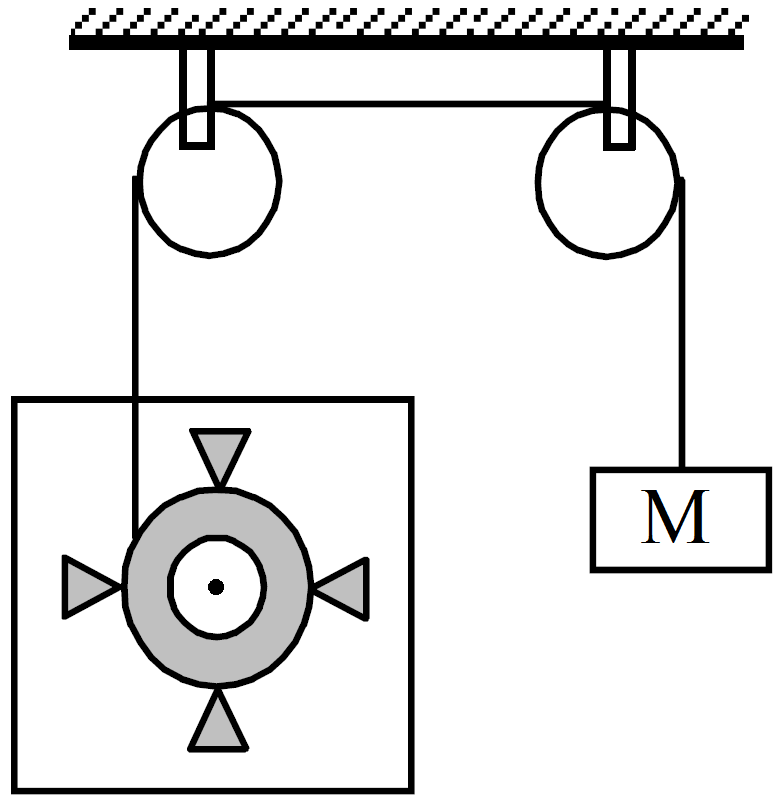
Figure, shows water in a container having 2.0mm thick walls made of a material of thermal conductivity $0.50\text{Wm}^{-1}{^{\circ}}\text{C}^{-1}.$ The container is kept in a melting-ice bath at 0°C. The total surface area in contact with water is $0.05m^2.$ A wheel is clamped inside the water and is coupled to a block of mass M as shown in the figure. As the block goes down, the wheel rotates. It is found that after some time a steady state is reached in which the block goes down with a constant speed of $10cms^{-1}$ and the temperature of the water remains constant at $1.0^\circ C.$ Find the mass M of the block. Assume that the heat flows out of the water only through the walls in contact. Take $g = 10ms^{-2}.$
Prove that energy remains conserved in electromagnetic induction.
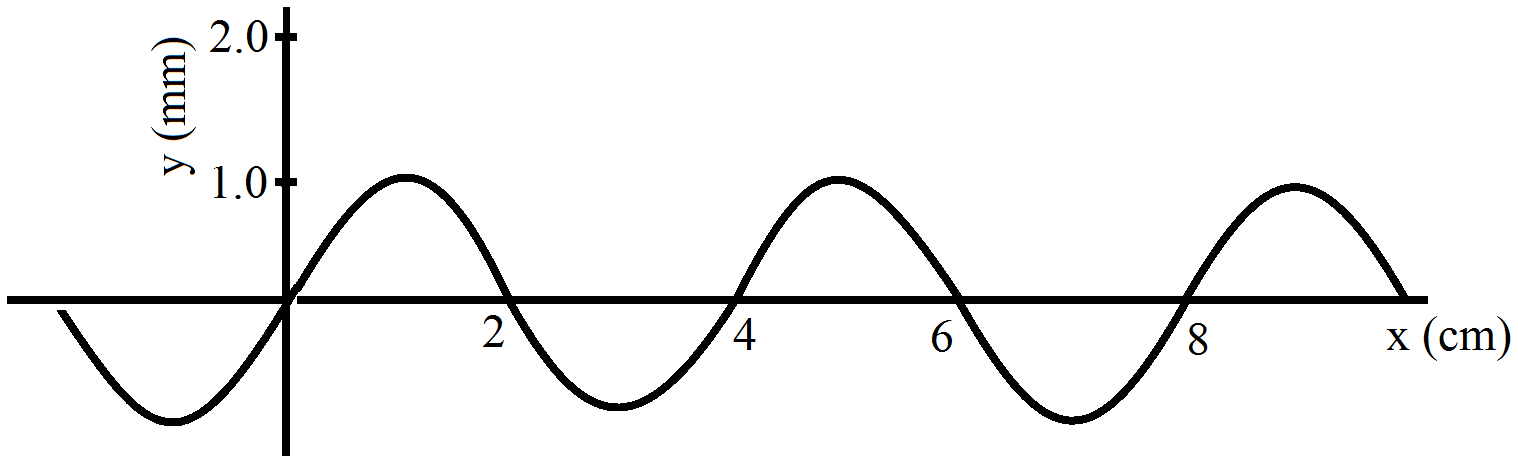
Figure shows a plot of the transverse displacements of the particles of a string at t = 0 through which a travelling wave is passing in the positive x-direction. The wave speed is 20cm/s. Find-
  1. The amplitude
  2. The wavelength
  3. The wave number
  4. The frequency of the wave.
A vessel of volume $125cm^3$ contains tritium $\big(\text{ }^3\text{H,t}_{\frac{1}{2}}=12.3\text{y}\big)$ at 500 kPa and 300K. Calculate the activity of the gas.
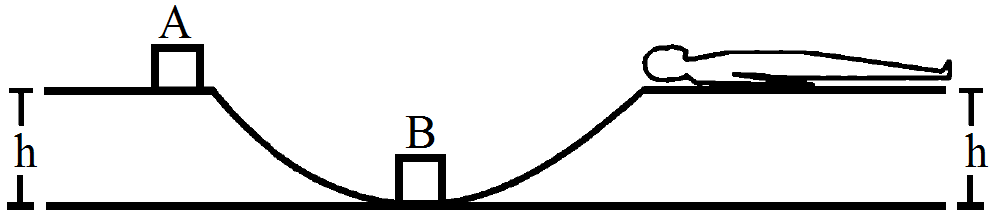
The track shown in figure is frictionless. The block B of mass 2m is lying at rest and the block A of mass m is pushed along the track with some speed. The collision between A and B is perfectly elastic. With what velocity should the block A be started to get the sleeping man awakened?
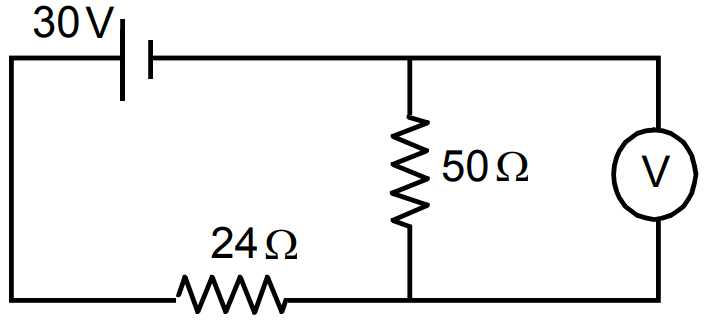
The voltmeter shown in the figure. reads 18V across the $50\Omega$ resistor. Find the resistance of the voltmeter.