Question
Calculate the temperature which has same numeral value on celsius and Fahrenheit scale.

Answer

Let the required temperature is x0C = x0F
$\frac{\text{C}}{100}=\frac{\text{F}-32}{180}$
$\Rightarrow\frac{\text{x}}{5}=\frac{\text{x}-32}{9}$
$\Rightarrow5\text{x}-160=9\text{x}$
$\Rightarrow-9\text{x}+5\text{x}=160$
$\Rightarrow-4\text{x}=160$
$\Rightarrow\text{x}=\frac{160}{-4}=-40^\circ$
$\therefore-40^\circ\text{F}=-40^\circ\text{C}$

Need a full question paper?

Generate a complete, print-ready paper with questions like this in minutes — across 16+ boards, with answer keys.
Start Generating Free

Similar questions

Work done by a force is given by $\text{W}=\vec{\text{F}.}\vec{\text{S}}\text{ Where}\vec{\text{ F}}$ is the force and $\vec{\text{S}}$is the displacement. Show that:
  1. Work done is also equal to change in K.E.
  2. Work done is also equal to change in potential energy using this expression.
A football is kicked into the air vertically upwards. What is its
  1. acceleration, and
  2. velocity at the highest point?
Can you associate vectors with (a) the length of a wire bent into a loop, (b) a plane area, (c) a sphere? Explain
Experiments show that the frequency (n) of a tuning fork depends upon the length (I) of the prong, the density (d) and the Young's modulus (Y) of its material. From dimensional considerations, find a possible relation for the frequency of the tuning fork.
Visible light has wavelengths in the range of 400nm to 780nm. Calculate the range of energy of the photons of visible light.
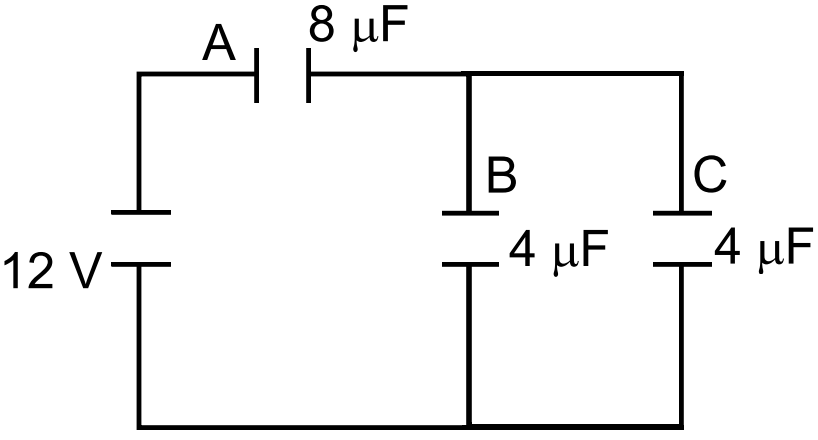
Find the charge appearing on each of the three capacitors shown in figure.

Weighing the Earth : You are given the following data: $g=9.81 ms ^{-2}$, $R_E=6.37 \times 10^6 m$, the distance to the moon $R$ $=3.84 \times 10^8 m$ and the time period of the moon's revolution is 27.3 days. Obtain the mass of the Earth $M_E$ in two different ways.
The vector sum of a system of non-collinear forces acting on a rigid body is given to be non-zero. If the vector sum of all the torques due to the system of forces about a certain point is found to be zero, does this mean that it is necessarily zero about any arbitrary point?
State first law of thermodynamics. Why is $C_p>C_v$ ? Derive the relation $C_p-C_v=R$ for an ideal gas.
Estimate the total number of air molecules (inclusive of oxygen, nitrogen, water vapour and other constituents) in a room of capacity 25.0m3 at a temperature of 27°C and 1 atm pressure.