Question
Can a process on an ideal gas be both adiabatic and isothermal?

Answer

No,
In a system either temperature varies or it heat varies.
In case of ideal gas Internal energy is function of temperature only thus for isothermal process change in internal energy is zero.
Now, since process is adiabatic thus heat exchange is zero.
therefore, work done is also zero.

Need a full question paper?

Generate a complete, print-ready paper with questions like this in minutes — across 16+ boards, with answer keys.
Start Generating Free

Similar questions

Poynting vectors $\vec{S}$ is defined as a vector whose magnitude is equal to the wave intensity and whose direction is along the direction of wave propogation. Mathematically, it is given by $\vec{S}=\frac{1}{\mu_0} \vec{E} \times \vec{B}$. Show the nature of $S$ vs $t$ graph.
Define the distance of closest approach. An α-particle of kinetic energy 'K' is bombarded on a thin gold foil. The distance of the closest approach is 'r'. What will be the distance of closest approach for an α-particle of double the kinetic energy?
A photographic plate records sufficiently intense lines when it is exposed for 12s to a source of 10W. How long should it be exposed to a 12W source radiating the light of same colour to get equally intense lines?
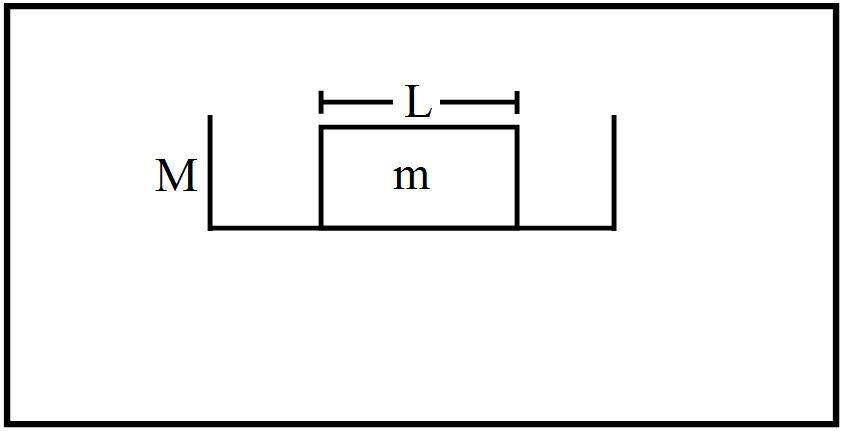
Consider a gravity-free hall in which a tray of mass M, carrying a cubical block of ice of mass m and edge L, is at rest in the middle. If the ice melts, by what distance does the centre of mass of "the tray plus the ice" system descend?
In a standing wave pattern in a vibrating air column, nodes are formed at a distance of 4.0cm. If the speed of sound in air is 328m/s, what is the frequency of 73 the source?
What is cyclotron ? State its two limitations.
A man stands before a large wall at a distance of 50.0m and claps his hands at regular intervals. Initially, the interval is large. He gradually reduces the interval and fixes it at a value when the echo of a clap merges with the next clap. If he has to clap 10 times during every 3 seconds, find the velocity of sound in air.
Draw equipotential surface due to the following :(i) Any electric dipole(ii) Two identical positive charges separated by some distance.
You are facing a circular wire carrying an electric current. The current is clockwise as seen by you. Is the field at the centre coming towards you or going away from you?
A resistance is connected to an $AC$ source. If a capacitor is included in the series circuit, will the average power absorbed by the resistance increase or decrease? If an inductor of small inductance is also included in the series circuit, will the average power absorbed increase or decrease further?