Question
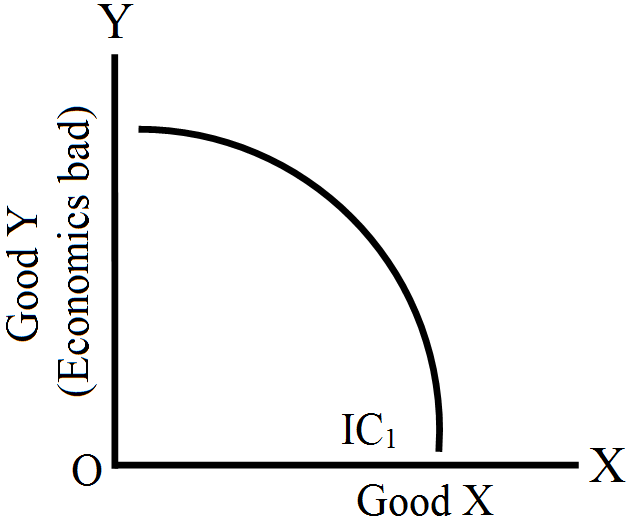
Can an Indifference Curve be concave to the origin, if so then when?
Answer

An Indifference Curve can be concave to the origin only when Marginal Rate of Substitution (MRS) is rising, i.e. a consumer is willing to sacrifice greater and greater units of the other good (say Y) for every additional unit of good X. This generally happens in case of economic bad goods (such as liquor, tobacco, cigarettes, etc).

Need a full question paper?

Generate a complete, print-ready paper with questions like this in minutes — across 16+ boards, with answer keys.

Start Generating Free

Similar questions

Complete the following table.
Units of labour 0 1 2 3 4 5
Total product - - - - - -
Average product - - - - - -
Marginal product 0 10 12 14 14 12
How does the budget line change if a consumer's income increases from ₹ 20 to ₹ 40 but the price remain unchanged?
Why the Total Revenue curve of a competitive firm faces a straight line passing through origin?
Explain why the equilibrium price of a commodity is determined at that level of output at which its demand equals its supply.
There are two factories employing 100 and 80 men, respectively. If the arithmetic mean of their monthly salaries are Rs.575 and Rs.625, then find the arithmetic mean of the salaries of both the factories together.
When price of a commodity falls by 20%, the quantity demanded of it increases by 80%. Find out its price elasticity of demand.
Explain how the supply of a commodity is affected by the change in the prices of other products.
A consumer consumes only two goods X and Y. The Marginal Rate of Substitution is 1. Prices of X and Y are ₹ 3 and ₹ 4 per unit respectively. Is the consumer in equilibrium? What will be further reaction of the consumer? Give reason.
China is also an emerging economy like India, however it keeps on inventing new and further advanced technologies. Do you agree that if they keep on doing so, one day will come, when there will be no central problems in China?
Identify the following as extension, contraction, increase or decrease in demand.
  1.  
Price (₹)
Demand (units)
10
20
12
15
  1.  
Price (₹)
Demand (units)
10
20
10
15
  1.  
Price (₹)
Demand (units)
12
15
10
20
  1.  
Price (₹)
Demand (units)
10
20
10
30