Question
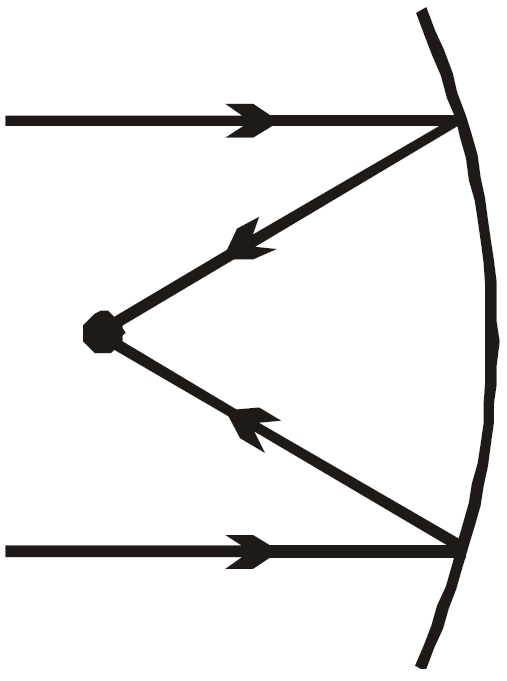
Can mirrors give rise to chromatic aberration?

Answer

No,

For all colour Ray focal length is $\frac{\text{R}}{2}$ so for all rays image is formed at same point hence no chromatic aberration.

Need a full question paper?

Generate a complete, print-ready paper with questions like this in minutes — across 16+ boards, with answer keys.
Start Generating Free

Similar questions

Can we decide whether change in internal energy of a system is due to heating or performance of work?
If a gas is suddenly compressed, its temperature increases, why?
Is it possible to have a collision in which all kinetic energy is lost? Give example.
Can two streamlines cross each other, why?
A batsman hits back a ball straight in the direction of the bowler without changing its initial speed of $12 m s ^{-1}$. If the mass of the ball is $0.15 kg$, determine the impulse imparted to the ball. (Assume linear motion of the ball)
Explain this statement clearly:
“To call a dimensional quantity ‘large’ or ‘small’ is meaningless without specifying a standard for comparison”. In view of this, reframe the following statements wherever necessary:
  1. Atoms are very small objects
  2. A jet plane moves with great speed
  3. The mass of Jupiter is very large
  4. The air inside this room contains a large number of molecules
  5. A proton is much more massive than an electron
  6. The speed of sound is much smaller than the speed of light.
A charged particle is projected at a very high speed perpendicular to a uniform magnetic field. The particle will:
  1. Move along a circle.
  2. Move along a curve with increasing radius of curvature.
  3. Move along a curve with decreasing radius of curvature.
  4. Move along a straight line.
For any arbitrary motion in space, which of the following relations are true:
$\text{v}_\text{average}=\frac{1}{2}(\text{v}(\text{t}_1)+\text{v}(\text{t}_2))$
(The ‘average’ stands for average of the quantity over the time interval t1 to t2)
If the earth did not have an atmosphere it would become intolerable cold. Why?
What is the position vector of inst. velocity and inst. acceleration of particle moving in a circular path with a constant speed?