MCQ
Can the resultant of $2$ vectors be zero
  • A
    Yes, when the $2$ vectors are same in magnitude and direction
  • B
    No
  • Yes, when the $2$ vectors are same in magnitude but opposite in sense
  • D
    Yes, when the $2$ vectors are same in magnitude making an angle of $\frac{{2\pi }}{3}$ with each other
Answer

Correct option: C.
Yes, when the $2$ vectors are same in magnitude but opposite in sense
c
Yes, when the $2$ vectors are same in magnitude but opposite in sense

Need a full question paper?

Generate a complete, print-ready paper with questions like this in minutes — across 16+ boards, with answer keys.

Start Generating Free

Similar questions

If minimum possible work is done by a refrigerator in converting $100\; grams$ of water at $0^{\circ} C$ to ice, how much heat (in calories) is released to the surrounding at temperature $27^{\circ} C$ (Latent heat of ice $=80 Cal / gram$ ) to the nearest integer?
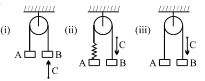
In the figure $(i), (ii)$ & $(iii)$ shown the objects $A, B$ & $C$ are of same mass. String, spring & pulley are massless. $C$ strikes $B$ with velocity $‘u’$ in each case and sticks to it. The ratio of velocity of $B$ in case $(i)$ to $(ii)$ to $(iii)$ is
The dimensional formula of Avagadro's number is:
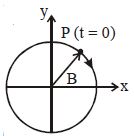
Figure shows the circular motion of a particle. The radius of the circle, the period, sense of revolution and the initial position are indicated on the figure. The simple harmonic motion of the $x-$ projection of the radius vector of the rotating particle $P$ is
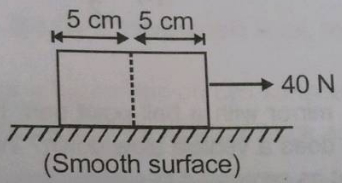
A block of mass $m$ as shown in figure is pulled by a force $40 \,N$. The tension at the middle of the block is ........... $N$
A uniform spherical planet (Radius $R$) has acceleration due to gravity at its surface $g.$ Points $P$ and $Q$ located inside and outside the planet have acceleration due to gravity $\frac{g}{4} .$ Maximum possible separation between $P$ and $Q$ is
The dimensions of physical quantity $X$ in the equation Force $ = \frac{X}{{{\rm{Density}}}}$ is given by
The relative velocity VBA OR VAB is zero for two particles moving along x-axis uniformly. The position-time graph for this situation will be:
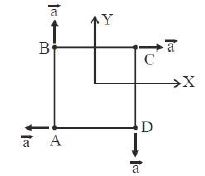
Four particles $A, B, C$ and $D$ with masses $m_A=m, m_B=2m, m_C=3m$ and $m_D=4m$ are at the corners of a square. They have accelerations of equal magnitude with directions as shown. The acceleration of the centre of mass of the particles is
A tube of length $L$ is filled completely with an incompressible liquid of mass $M$ and closed at both the ends. The tube is then rotated in a horizontal plane about one of its ends with a uniform angular velocity $\omega $. The force exerted by the liquid at the other end is