Question
Can two equipotential surfaces cut each other?

Answer

At the point of intersection, two normals can be drawn. Also, we know that electric field lines are perpendicular to the equipotential surface. This implies that at that point two different directions of the electric field are possible, which is not possible physically.
Hence, two equipotential surfaces cannot cut each other.

Need a full question paper?

Generate a complete, print-ready paper with questions like this in minutes — across 16+ boards, with answer keys.
Start Generating Free

Similar questions

The sum of the magnitude of two forces acting at a point is 18N and the magnitude of their resultant is 12N. If the resultant is at 90° with the force of smaller magnitude, what are the magnitude of forces?
Two parallel wires carry equal currents of 10A along the same direction and are separated by a distance of 2.0cm. Find the magnetic field at a point which is 2.0cm away from each of these wires
Show that range of projection of a projectile for two angles of a projection $\alpha$ and $\beta$ is same where $\alpha+\beta=90^\circ.$
The average translational kinetic energy of air molecules is 0.040eV (1eV = 1.6 × 10-19J). Calculate the temperature of the air. Boltzmann constant k = 1.38 × 10-23JK-1.
It is a well known fact that during a total solar eclipse the disk of the moon almost completely covers the disk of the sun. The distance of moon (rME) and sun (rSE) from the earth surface is 3.84 × 10⁸m and 1.496 × 10¹¹m while the diameter of Sun is 1.390 × 109m. Determine the approximate diameter of the moon.
A U-tube contains water and methylated spirit separated by mercury. The mercury columns in the two arms are in level with 10.0cm of water in one arm and 12.5cm of spirit in the other. What is the specific gravity of spirit?
In a typical fission reaction, the nucleus is split into two middle-weight nuclei of unequal masses. Which of the two (heavier or lighter) has greater kinetic energy? Greater linear momentum?
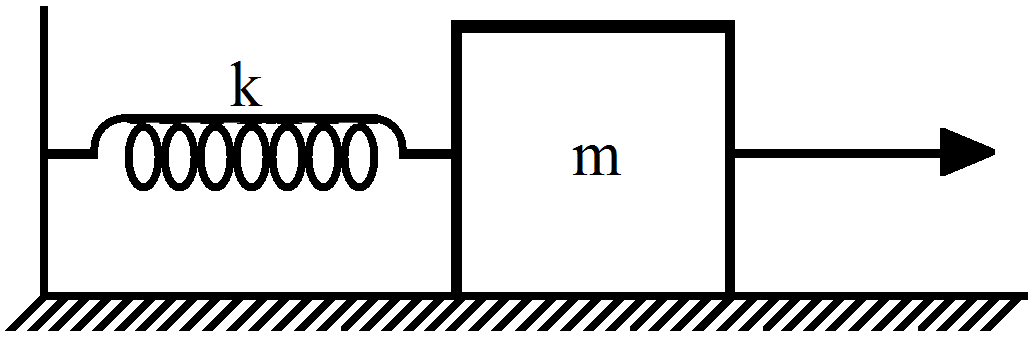
The spring shown in figure is unstretched when a man starts pulling on the cord. The mass of the block is M. If the man exerts a constant force F, find
  1. The amplitude and the time period of the motion of the block,
  2. The energy stored in the spring when the block passes through the equilibrium position and,
  3. The kinetic energy of the block at this position.

A light ray is incident at an angle of 45° with the normal to a $\sqrt{2}\text{cm}$ thick plate $(\mu = 2.0)$. Find the shift in the path of the light as it emerges out from the plate.
By using the method of dimension, check the accuracy of the following formula : $ \text{T}=\frac{\text{rh}\rho\text{g}}{2\cos\theta},$where T is the surface tension, h is the height of the liquid,$\rho$ is the density of the liquid, g acceleration due to gravity $\theta$ angle of contact, and r is the radius of the tube.