Question
Can we have magnetic hysteresis in paramagnetic or diamagnetic substances?

Answer

No, magnetic hysteresis is the lagging of intensity of magnetization (I) behind magnetising force (H). When diamagnetic and paramagnetic materials are placed in a magnetic field they get weekly magnetised. Also, they lose their magnetization as the magnetic field is removed (low retentively). Therefore, they do not form magnetic hysteresis curve.

Need a full question paper?

Generate a complete, print-ready paper with questions like this in minutes — across 16+ boards, with answer keys.
Start Generating Free

Similar questions

A charged particle having a charge of $-2.0 \times 10^{-6}C$ is placed close to a nonconducting plate having a surface charge density $4.0 \times 10^{-5}Cm^{-2}$. Find the force of attraction between the particle and the plate.
An object of size 3.0 cm is placed 14 cm in front of a concave lens of focal length 21 cm. Describe the image produced by the lens. What happens if the object is moved further away from the lens?
A uranium reactor develops thermal energy at a rate of 300MW. Calculate the amount of $^{235}U$ being consumed every second. Average released per fission is 200MeV.
The ground state energy of hydrogen atom is – 13.6 eV. If an electron makes a transition from an energy level – 0.85 eV to – 3.4 eV, calculate the wavelength of the spectral line emitted.To which series of hydrogen spectrum does this wave length belong?
Find the angle of minimum deviation for an equilateral prism made of a material of refractive index 1.732. What is the angle of incidence for this deviation?
Three resistors $1\ \Omega,\ 2\ \Omega\ \text{and}\ 3\ \Omega$ are combined in series. What is the total resistance of the combination?
If the combination is connected to a battery of emf 12 V and negligible internal resistance, obtain the potential drop across each resistor.
In a photoelectric experiment, the collector plate is at 2.0V with respect to the emitter plate made of copper ($\phi$ - 4.5eV). The emitter is illuminated by a source of monochromatic light of wavelength 200 run. Find the minimum and maximum kinetic energy of the photoelectrons reaching the collector.
A change of 0.2mA in the base current causes a change of 5mA in the collector current for a common emitter amplifier.
  1. Find the ac current gain of the transistor.
  2. If the input resistance is $2\text{k}\Omega$ and its voltage gain is 75, calculate the load resistor used in the circuit.
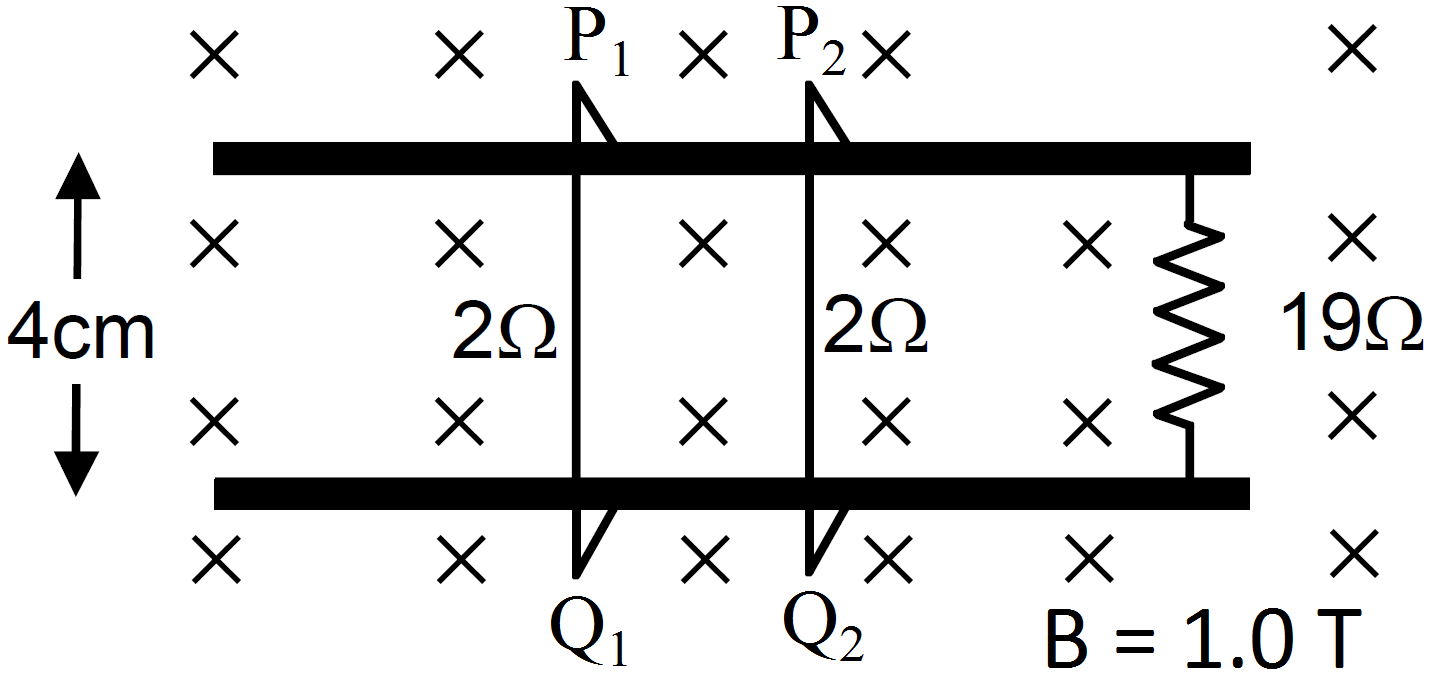
Consider the situation shown in figure. The wires $P_1Q_1$ and $P_2Q_2$ are made to slide on the rails with the same speed 5cm/s. Find the electric current in the $19\Omega$ resistor if:
  1. Both the wires move towards right.
  2. If $P_1Q_1$ moves towards left but $P_2Q_2$ moves towards right.
A transformer has 50 turns in the primary and 100 in the secondary. If the primary is connected to a 220V DC supply, what will be the voltage across the secondary?