MCQ
Carbon -12 atom has:
  • A
    6 electrons, 6 protons, and 6 neutrons.
  • B
    6 electrons, 12 protons, and 6 neutrons.
  • C
    12 electrons, 6 protons, and 6 neutrons.
  • D
    18 electrons, 6 protons, and 6 neutrons.

Need a full question paper?

Generate a complete, print-ready paper with questions like this in minutes — across 16+ boards, with answer keys.
Start Generating Free

Similar questions

Rock salt is an ore of one of the following metals. This metal is:
Three beakers labelled as A, B and C each containing 25mL of water were taken. A small amount of NaOH, anhydrous CuSO4 and NaCl were added to the beakers A, B and C respectively. It was observed that there was an increase in the temperature of the solutions contained in beakers A and B, whereas in case of beaker C, the temperature of the solution falls. Which one of the following statement (s) is (are) correct?
  1. In beakers A and B, exothermic process has occurred.
  2. In beakers A and B, endothermic process has occurred.
  3. In beaker C, exothermic process has occurred.
  4. In beaker C, endothermic process has occurred.
When ethanol reacts with sodium metal, it forms two products. These products are:
Why does carbon form compounds mainly by covalent bonding?
Which of the given statement is correct or wrong:
Statement A: Ethane decolorizes bromine water whereas ethyne does not.
Statement B: Mixture of water and alcohol is used in radiators of vehicles in cold countries.
10 mL of a solution of NaOH is found to be completely neutralised by 8 mL of a given solution of HCl. If we take 20 mL of the same solution of NaOH, the amount of HCl solution (the same solution as before) required to neutralise it will be
The number of covalent bonds in pentane (molecular formula C5H12) is:
  1. 5
  2. 12
  3. 17
  4. 16
Barium chloride on reacting with ammonium sulphate forms barium sulphate and ammonium chloride. Which of the following correctly represents the type of the reaction involved?
  1. Displacement reaction.
  2. Precipitation reaction.
  3. Combination reaction.
  4. Double displacement reaction.
  1. Only 1
  2. Only 2
  3. Only 4
  4. 2 and 4
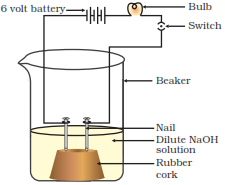
In an attempt to demonstrate electrical conductivity through an electrolyte, the following apparatus figure, was set up. Which among the following statement(s) is (are) correct?

  1. Bulb will not glow because electrolyte is not acidic.
  2. Bulb will glow because NaOH is a strong base and furnishes ions for conduction.
  3. Bulb will not glow because circuit is incomplete.
  4. Bulb will not glow because it depends upon the type of electrolytic solution.
  1. 1 and 3
  2. 2 and 4
  3. 2 only
  4. 4 only

Which of the following metals are extracted by the electrolysis of their molten chlorides?