MCQ
Carbon differs from other elements of the group. Which is the false statement
  • A
    Due to its marked tendency to form long chains (catenation)
  • B
    Due to its unique ability to form multiple bonds
  • Due to $d$ - orbital in penultimate shell
  • D
    Due to its limitation of co-ordination number $4$
Answer

Correct option: C.
Due to $d$ - orbital in penultimate shell
c
(c) Carbon has $2$ electrons in their penultimate shell configuration so due to $d$ - orbital in penultimate shell is false statement.

Need a full question paper?

Generate a complete, print-ready paper with questions like this in minutes — across 16+ boards, with answer keys.

Start Generating Free

Similar questions

The entropy values (in $JK^{-1}$ $mol^{-1}$) of $H_{2(g)} = 130.6, Cl_{2(g)} = 223.0$ and $HCl_{(g)} = 186.7$ at $298\, K$ and $1$ $atm$ pressure. Then entropy change for the reaction $H_{2(g)} + Cl_{2(g)} \to 2HCl_{(g)}$ is :-
A quantity of $PC{l_5}$ was heated in a $10$ litre vessel at ${250\,^o}C$; $PC{l_5}_{(g)}$ $\rightleftharpoons$ $PC{l_3}_{(g)} + C{l_2}_{(g)}$. At equilibrium the vessel contains $0.1$ $mole$ of $PC{l_5}\,0.20$ $mole$ of $PC{l_3}$ and $0.2$ $mole$ of $C{l_2}$. The equilibrium constant of the reaction is
$\underset{(d)}{\mathop{\begin{matrix}
   C{{H}_{3}}-CH-OAc  \\
   |  \\
   Et  \\
\end{matrix}}}\,$ $\xrightarrow{H{{O}^{-}}}$ ( $d=$ dextro rotatory)  Product of the reaction is
What is the use of tetraethyl lead
The minimum volume of water required to dissolve $0.1\,g$ lead $(II)$ chloride to get a saturated solution ($K_{SP}$ of $PbCl_2 = 3.2 \times 10^{-8}$; atomic mass of $Pb= 207\, u$) is......$L$
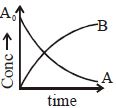
For the reaction, $A \to nB$. At the point of intersection of the two curves, the concentration of $B$ is given by .....
A mixture of $H_2$ and $O_2$ at $1\, atm$ pressure. Contains $20\%$ by weight of $H_2$ then find out the partial pressure of $H_2$. ............ $atm$.
$2, 4$ -hexadiyne $(C_6H_6)$ is allowed to react with $Li $ in $NH_3 (liq)$. The  product obtained is treated with $1$ equivalent of $Cl_2$ in $CCl_4$. Which of the  following constitutional isomers are possible products ?
Which of the following statement is correct
For the reactions

$A\, \rightleftharpoons \,B$                     ${K_C} = 2$

$B\, \rightleftharpoons \,C$                    ${K_C} = 3$

$C\, \rightleftharpoons \,D+E$               ${K_C} = 5$

$K_C$ for the reaction $A\, \rightleftharpoons \,D+E$ is
