MCQ
Carboxylic acids react with diazomethane to form
  • A
    Amine
  • B
    Alcohol
  • Ester
  • D
    Amide

Answer

Correct option: C.
Ester
c
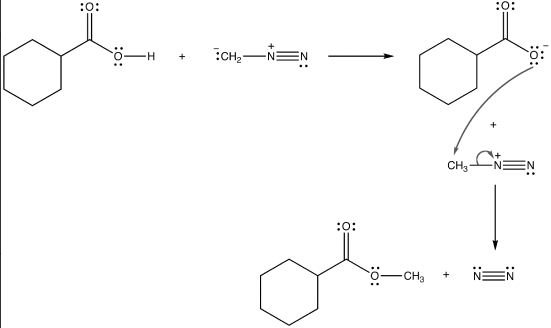
Diazomethane provides the necessary $\mathrm{CH}_{2}$ group to form an ester (esterification using diazomethane)

Mechanism as shown

Option $\mathrm{C}$ is correct.
Need a full question paper?

Generate a complete, print-ready paper with questions like this in minutes — across 16+ boards, with answer keys.

Start Generating Free

Similar questions

Which of the following does not reduce Tollen’s reagent
The optically active species among the following is
The frequency of a certain line of lyman series of atomic spectrum of $H$ atom satisfy the following condition 
$(i)$ It is the sum of frequency of another lyman line and balmer line.
$(ii)$ It is the sum of frequency of a certain line, lyman line and a paschen line
$(iii)$ It is the sum of frequency of a lyman and a paschen line but no bracket line
To what transition does this frequency correspond?
The correct decreasing order of energy, for the orbitals having, following set of quantum numbers.

$(A)$ $n=3,1=0, m=0$

$(B)$ $n=4,1=0, m=0$

$(C)$ $n =3,1=1, m =0$

$(D)$ $n=3,1=2, m=1$

The noble gases have closed-shell electronic configuration and are monoatomic gases under normal conditions. The low boiling points of the lighter noble gases are due to weak dispersion forces between the atoms and the absence of other interatomic interactions.

The direct reaction of xenon with fluorine leads to a series of compounds with oxidation numbers $+2,+4$ and $+6$ . XeF $4$ reacts violently with water to give $\mathrm{XeO}_3$. The compounds of xenon exhibit rich stereochemistry and their geometries can be deduced considering the total number of electron pairs in the valence shell.

$1.$ Argon is used in arc welding because of its

$(A)$ low reactivity with metal 

$(B)$ ability to lower the melting point of metal

$(C)$ flammability 

$(D)$ high calorific value

$2.$  The structure of $\mathrm{XeO}_3$ is

$(A)$ linear  $(B)$ planar  $(C)$ pyramidal  $(D)$ $T$-shaped

$3.$  $\mathrm{XeF}_4$ and $\mathrm{XeF}_6$ are expected to be

$(A)$ oxidizing  $(B)$ reducing  $(C)$ unreactive  $(D)$ strongly basic

Give the answer question $1,2$ and $3.$
One litre of an aqueous solution contain $0.15\,mole$ of $CH_3COOH \,(pK_a = 4.8)$ and $0.15\,mole$ of $CH_3COONa$. After the addition of $0.05\,mole$ of solid $NaOH$ to this solution, the $pH$ will be
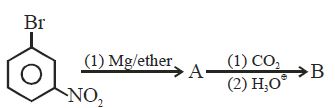
What will vbe the final product $B$ in following reaction?
If $EAN$ of central metal cation $M^{2+}$ in a non-chelating complex is $36$ and  atomic no. of metal $M$ is $26$, then the number of monodentate ligand in this  complex are 
For which of the processes is $\Delta S$ negative
A co-ordination complex compound of cobalt has the molecular formulae containing five ammonia molecules, one nitro group and two chlorine atoms for one cobalt atom. One mole of this compound produces three mole ions in an aqueous solution on reacting with excess of $AgN{O_3},$ $AgCl$ precipitate. The ionic formula for this complex would be: