MCQ
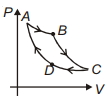
Carnot cycle is plotted in $P-V$ graph. Which portion represents an isothermal expansion?
  • $A B$
  • B
    $B C$
  • C
    $C D$
  • D
    $D A$

Answer

Correct option: A.
$A B$
a
(a)

$A B$ is isothermal expansion. $B C$ is adiabatic expansion $C D$ is isothermal compression $\Delta A=$ adiabatic compression.

Need a full question paper?

Generate a complete, print-ready paper with questions like this in minutes — across 16+ boards, with answer keys.
Start Generating Free

Similar questions

If one end of a wire is fixed with a rigid support and the other end is stretched by a force of $10 \,N,$ then the increase in length is $0.5\, mm$. The ratio of the energy of the wire and the work done in displacing it through $1.5\, mm$ by the weight is
A hollow cylinder is rolling on an inclined plane, inclined at an angle of ${30^o}$ to the horizontal. Its speed after travelling a distance of $10\ m$ will be .......... $m/s$
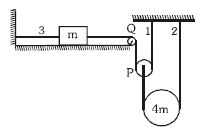
Shown in the diagram is a system of two bodies, a block of mass $m$ and a disc of mass $4\ m$ , held in equilibrium. If the string $3$ is burnt, find the acceleration of the disc. Neglect the masses of the pulleys $P$ and $Q$ . The co-efficient of friction between the block and horizontal surface is $0.5$ and friction between disc and string is zero ........ $m/s^2$
On a particular day, the relative humidity is $100\%$ and the room temperature is $30^\circ C,$ then the dew point is:
The displacement of a particle moving in a straight line depends on time as $x=\alpha t^3+\beta t^2+\gamma t+\delta$.The ratio of initial acceleration to its initial velocity depends
In which of the following cases the centre of mass of a rod is certainly not at its centre?
Two sirens situated one kilometer apart are producing sound of frequency $330 Hz$. An observer starts moving from one siren to the other with a speed of $2 m/s$. If the speed of sound be $330 m/s$, what will be the beat frequency heard by the observer
Two planets have masses $M$ and $16\, M$ and their radii are $a$ and $2\, a$ respectively. The separation between the centres of the planets is $10\, a.$ A body of mass $m$ is fired from the surface of the larger planet towards the smaller planet along the line joining their centres. For the body to be able to reach at the surface of smaller planet, the minimum firing speed needed is
Two blocks $A$ and $B$ of masses $5 \,kg$ and $3 \,kg$ respectively rest on a smooth horizontal surface with $B$ over $A$. The coefficient of friction between $A$ and $B$ is $0.5$. The maximum horizontal force (in $kg$ wt.) that can be applied to $A$, so that there will be motion of $A$ and $B$ without relative slipping, is
A jet engine works on the principle of