MCQ
Cathode ray consists of:
- APhotons.
- BElectrons.
- CProtons.
- DA-particles.
Generate a complete, print-ready paper with questions like this in minutes — across 16+ boards, with answer keys.
In a Young’s double slit experiment, the source illuminating the slits is changed from blue to violet. The width of the fringes
|
(a) Increases |
(b) Decreases |
(c) Becomes unequal |
(d) Remains constant |
The concept of stationary orbits was proposed by
|
(a) Neil Bohr |
(b) J.J. Thomson |
(c) Ruther ford |
(d) I. Newton |
If in the circuit shown below, the internal resistance of the battery is 1.5 W and VP and VQ are the potentials at P and Q respectively, what is the potential difference between the points P and Q
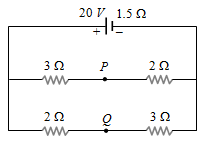
|
(a) Zero |
(b) 4 volts (VP > VQ) |
(c) 4 volts (VQ > VP) |
(d) 2.5 volts (VQ > VP) |
Two lenses of power + 12 and – 2 diopters are placed in contact. The combined focal length of the combination will be
|
(a) 8.33 cm |
(b) 1.66 cm |
(c) 12.5 cm |
(d) 10 cm |
A radioactive nucleus is being produced at a constant rate a per second. Its decay constant is l. If N0 are the number of nuclei at time t = 0, then maximum number of nuclei possible are
|
(a) |
(b) |
(c) N0 |
(d) |
The fact that electric charges are integral multiples of the fundamental electronic charge was proved experimentally by
|
(a) Planck |
(b) J.J. Thomson |
(c) Einstein |
(d) Millikan |
Bragg’s law for X-rays is
| (a) d sin θ = 2n λ | (b) 2dsin θ = n λ |
(c) n sin θ = 2 λ d |
(d) None of these |
For principal quantum number n = 3, the possible values of orbital quantum number ‘l’ are
|
(a) 1, 2, 3 |
(b) 0, 1, 2, 3 |
(c) 0, 1, 2 |
(d) –1, 0, +1 |


