Question

Cathode rays and canal rays produced in a certain discharge tube are deflected in the same direction if

(a) A magnetic field is applied normally

(b) An electric field is applied normally

(c) An electric field is applied tangentially

(d) A magnetic field is applied tangentially

Answer

(a) A magnetic field is applied normally

Need a full question paper?

Generate a complete, print-ready paper with questions like this in minutes — across 16+ boards, with answer keys.

Start Generating Free

Similar questions

The decay constant of radium is 4.28  per year. Its half life will be

(a) 2000 years

(b) 1240 years

(c) 63 years

(d) 1620 years

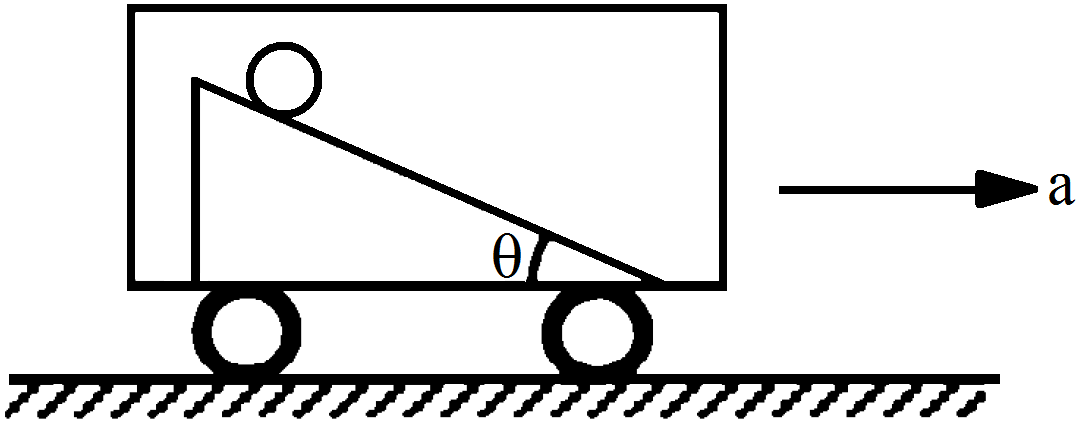
Figure shows a smooth inclined plane fixed in a car accelerating on a horizontal road. The angle of incline 0 is related to the acceleration a of the car as a = g tan°. If the sphere is set in pure rolling on the incline:

  1. It will continue pure rolling.
  2. It will slip down the plane.
  3. Its linear velocity will increase.
  4. Its linear velocity will slowly decrease.

Magnetic moments of two bar magnets may be compared with the help of

(a)  Deflection magnetometer

(b) Vibration magnetometer

(c) Both of the above

(d) None of the above

Which of the following helps us in the determination of the temperature of sun

(a) Kirchhoff's law

(b) Maxwell Boltzmann law

(c) Planck's law

(d) Stefan's law

Which of the following is the most suitable material for making permanent magnet?
Internal forces can change:
  1. The linear momentum but not the kinetic energy.
  2. The kinetic energy but not the linear momentum.
  3. Linear momentum as well as kinetic energy.
  4. Neither the linear momentum nor the kinetic energy.

An electron and a proton are in a uniform electric field, the ratio of their accelerations will be

(a) Zero

(b) Unity

(c) The ratio of the masses of proton and electron

(d) The ratio of the masses of electron and proton

What is the color of the interference fringe nearest to the central maximum in case the source light is white?

In the following reaction the value of ‘X’ is

(a)  

(b)  

(c)  

(d)  

A metal surface of work function 1.07eV is irradiated with light of wavelength 332nm. The retarding potential required to stop the escape of photo electron is: