MCQ
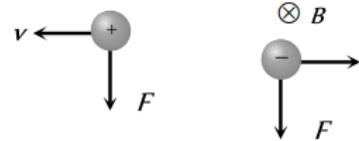
Cathode rays and canal rays produced in a certain discharge tube are deflected in the same direction if
  • A magnetic field is applied normally
  • B
    An electric field is applied normally
  • C
    An electric field is applied tangentially
  • D
    A magnetic field is applied tangentially
Answer

Correct option: A.
A magnetic field is applied normally
In discharge tube cathode rays (a beam of negative particles) and canal rays (positive rays)moves opposite to each other.
They will experience a magnetic force in the same direction, if a normal magnetic field is switched on

Need a full question paper?

Generate a complete, print-ready paper with questions like this in minutes — across 16+ boards, with answer keys.

Start Generating Free

Similar questions

The approximate wavelength of a photon of energy $2.48\  \mathrm{eV}$ is
An object is at a temperature of $400^{\circ} \mathrm{C}$. At what temperature would it radiate energy twice as fast? The temperature of the surroundings may be assumed to be negligible
The ratio of speed of an electron in ground state in Bohrs first orbit of hydrogen atom to velocity of light in air is
A projectile fired with initial velocity $u$ at some angle $\theta$ has a range $R$. If the initial velocity be doubled at the same angle of projection, then the range will be
Consider the following two statements 1. Linear momentum of a system of particles is zero 2. Kinetic energy of a system of particles is zero Then
Calculate the frequency of the second harmonic formed on a string of length $0.5 \mathrm{~m}$ and mass $2 \times 10 \mathrm{~kg}$ when stretched with a tension of $20 \mathrm{~N}$
Two simple harmonic motions are represented by the equations $y_1=0.1 \sin \left(100 \pi t+\frac{\pi}{3}\right)$ and $y_2=0.1 \cos \pi t .$ The phase difference of the velocity of particle $1$ with respect to the velocity of particle $2$ is
For an isothermal expansion of a perfect gas, the value of $\frac{\Delta P}{P}$ is equal
When a body moves in a circular path, no work is done by the force since,
A mass of $10 \mathrm{gm}$ moving with a velocity of $100 \mathrm{~cm} / \mathrm{s}$ strikes a pendulum bob of mass $10 \mathrm{gm}$. The two masses stick together. The maximum height reached by the system now is $\left(g=10 \mathrm{~m} / \mathrm{s}^2\right)$