MCQ
Cathode rays are similar to visible light rays in that
  • A
    They both can be deflected by electric and magnetic fields
  • B
    They both have a definite magnitude of wavelength
  • C
    They both can ionise a gas through which they pass
  • They both can expose a photographic plate
Answer

Correct option: D.
They both can expose a photographic plate
d
(d)Light consists of photons and cathode rays consists of electrons. However both effect the photographic plate.

Need a full question paper?

Generate a complete, print-ready paper with questions like this in minutes — across 16+ boards, with answer keys.

Start Generating Free

Similar questions

A particle is moving in a circular path of radius $r$ under the action of a force $F$. If at an instant velocity of particle is $v$, and speed of particle is increasing, then
Three capacitors each of $6\,\mu F$ are available. The minimum and maximum capacitances which may be obtained are
Surface of the lake is at $2°C$. Find the temperature of the bottom of the lake........ $^oC$
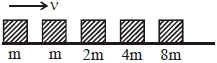
Blocks of masses $m , 2 m , 4 m$ and $8 m$ are arranged in a line on a frictionless floor. Another block of mass $m ,$ moving with speed $v$ along the same line (see figure) ollides with mass $m$ in perfectly inelastic manner. All the subsequent collisions are also perfectly inelastic. By the time the last block of mass $8 m$ starts moving the total energy loss is $p \%$ of the original energy. Value of $'p'$ is close to
The velocity of photon is proportional to (where $v$ is frequency)
The relation between root mean square speed $\left( v _{ rms }\right)$ and most probable speed $\left( v _{ p }\right)$ for the molar mass $M$ of oxygen gas molecule at the temperature of $300\, K$ will be
In resonance tube two successive positions of resonance are obtained at $15 \,cm$ and $48 \,cm$. If the frequency of the fork is $500 \,cps$, the velocity of sound is ......... $m / s$
A square loop of side $l$ is kept in a uniform magnetic field $B$ such that its plane makes an angle $\alpha$ with $\vec{B}$. The loop carries a current $i$. The torque experienced by the loop in this position is
Three particles each of mass $m$ are located at the vertices of an equilateral triangle $ABC$. They start moving with equal speeds $v$ each along the medians of the triangle and collide at its centroid $G$. If after collision, $A$ comes to rest and $B$ retraces its path along $GB,$ then $C$
A body of mass $m$ moves in a circular path with uniform angular velocity. The motion of the body has constant