MCQ
Cathode rays are
  • A
    Positive rays
  • B
    Neutral rays
  • C
    He rays
  • Electron waves

Answer

Correct option: D.
Electron waves
Cathode rays are beam of electrons.

Need a full question paper?

Generate a complete, print-ready paper with questions like this in minutes — across 16+ boards, with answer keys.
Start Generating Free

Similar questions

A spherical shell of radius $'R'$ carries uniformly distributed charge $'Q'$ is rotated about it's diameter with angular speed $\omega $ find it's magnetic moment
If an interference pattern have maximum and minimum intensities in $36: 1$ ratio then what will be the ratio of amplitudes
The dispersive powers of crown and flint glasses are $0.02$ and $0.04$ respectively. In an achromatic combination of lenses the focal length of flint glass lens is $40 \mathrm{~cm}$. The focal length of crown glass lens will be
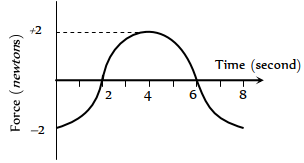
A force-time graph for a linear motion is shown in figure where the segments are circular. The linear momentum gained between zero and 8 second is

Image

A car is moving along a straight horizontal road with a speed $v_0$. If the coefficient of friction between the tyres and the road is $\mu$, the shortest distance in which the car can be stopped is
An ideal heat engine working between temperature $T$ and $T$ has an efficiency $\eta$, the new efficiency if both the source and sink temperature are doubled, will be
The fundamental frequency of a sonometre wire is $n$. If its radius is doubled and its tension becomes half, the material of the wire remains same, the new fundamental frequency will be
A man suffering from myopia can read a book placed at $10 \mathrm{~cm}$ distance. For reading the book at a distance of $60 \mathrm{~cm}$ with relaxed vision, focal length of the lens required will be
One mole of an ideal gas expands at a constant temperature of 300 $K$ from an initial volume of 10 litres to a final volume of 20 litres. The work done in expanding the gas is $(R=8.31 \mathrm{~J} / \mathrm{mole}-K)$
Two bodies $A$ and $B$ having masses in the ratio of $3: 1$ possess the same kinetic energy. The ratio of their linear momenta is then