MCQ
$CC{l_4}$ has the hybridisation
  • A
    $s{p^3}d$
  • B
    $ds{p^2}$
  • C
    $sp$
  • $s{p^3}$

Answer

Correct option: D.
$s{p^3}$
d
$CCl _4$ has $4+4(7)=32$ valence electrons. $CCl _4$ has a tetrahedral arrangement of the electron pairs about the carbon atom that requires $sp ^3$ hybridization. The four $sp ^3$ hybrid orbitals from carbon are used to form the four bonds to chlorine.

Need a full question paper?

Generate a complete, print-ready paper with questions like this in minutes — across 16+ boards, with answer keys.

Start Generating Free

Similar questions

Which one among the following is the correct option for right relationship between $\mathrm{C}_{\mathrm{P}}$ and $\mathrm{C}_{\mathrm{V}}$ for one mole of ideal gas?
The most stable ion is
For an exothermic reaction, following two steps are involved.
Step $1. A + B \to  I\, (slow)$
Step $2. I \to  AB\, (fast)$
Which of the following graphs correctly represent this reaction ?
Which of the following statement(s) is/are correct?

$(A)$ The $pH$ of $1 \times 10^{-8}\,M\,HCl$ solution is $8$.

$(B)$ The conjugate base $H _2 PO _4^{-}$is $HPO _4{ }^{2-}$.

$(C)$ $K _{ w }$ increases with increase in temperature.

$(D)$ When a solution of weak monoprotic acid is titrated against a strong base at half neutralisation point, $pH =\frac{1}{2} pK _{ a }$

Choose the correct answer from the option given below.
All element in $3$$^{rd}$ period have
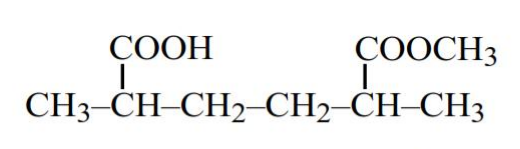
The IUPAC name of the following compound is :
Image
Which one of the following on reaction with lucas reagent gives white precipitate fastest
The hypothetical reaction : $2A + B \to C + D$ is catalyzed by $E$ as indicated in the possible mechanism below -

Step$-1$ : ${\text{A  +  E }} \rightleftharpoons AE$ (fast)

Step$-2$ :${\text{AE  +  A }} \to {A_2} + E$ (slow)

Step$-3$ :${{\text{A}}_2}{\text{ +  B }} \to {\text{D}}$ (fast)

what rate law best agrees with this mechanism

Some inert gas is added at constant volume to the following reaction at equilibrium

$N{H_4}HS(s) \rightleftharpoons N{H_3}(g) + H_2S(g)$

Predict the effect of adding the inert gas

The atomic radii from $Cr$ to $Cu$ is almost identical because of