MCQ
Cell reaction is spontaneous, when
- A$E_{red}^o$ is negative
- ✓$\Delta G$ is negative
- C$E_{oxi}^o$ is positive
- D$\Delta G$ is positive
If the electrode potential is assumed to be positive then, When $\Delta G\, <\,0$, the cell reaction is spontaneous.
When $\Delta G \,>\,0$, the cell reaction is non-spontaneous.
When $\Delta G \,=\,0$, the reaction is in equilibrium.
Therefore, the correct answer is option $B$.
Generate a complete, print-ready paper with questions like this in minutes — across 16+ boards, with answer keys.
$(1)$ $(CH_3)_3 {\bar{\ddot{C}}}$
$(2)$ ${(C{H_3})_2}{\bar {\ddot {CH}}}$
$(3) $ $C{H_3}{\bar{\ddot{C{H_2}}}}$
$(4)$ ${C_6}{H_5}{\bar{\ddot{C{H_2}}}}$ is
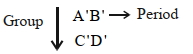
Which of the following is/are true about $\mathrm{A}^{\prime}, \mathrm{B}^{\prime}, \mathrm{C}^{\prime}$ and $\mathrm{D}^{\prime}$ ?
$A$. Order of atomic radii: $\mathrm{B}^{\prime}<\mathrm{A}^{\prime}<\mathrm{D}^{\prime}<\mathrm{C}^{\prime}$
$B$. Order of metallic character: $\mathrm{B}^{\prime}<\mathrm{A}^{\prime}<\mathrm{D}^{\prime}<\mathrm{C}^{\prime}$
$C$. Size of the element : $\mathrm{D}^{\prime}<\mathrm{C}^{\prime}<\mathrm{B}^{\prime}<\mathrm{A}^{\prime}$
$D$. Order of ionic radii : $\mathrm{B}^{\prime+}<\mathrm{A}^{\prime+}<\mathrm{D}^{\prime+}<\mathrm{C}^{\prime+}$
Choose the correct answer from the options given below :