MCQ
Centre of mass is a point:
  • A
    Which is geometric centre of a body.
  • B
    From which distance of particles are same.
  • Where the whole mass of the body is supposed the.
  • D
    None of these.

Answer

Correct option: C.
Where the whole mass of the body is supposed the.
Center of mass of a body is a point where we can assume all mass is concentrated.

Need a full question paper?

Generate a complete, print-ready paper with questions like this in minutes — across 16+ boards, with answer keys.
Start Generating Free

Similar questions

The radius of a thin wire is $0.16\; mm$. The area of cross-section taking significant figure into consideration in square millimeters is?
Consider a bowl filled with water on which some black pepper powder have been sprinkled uniformly. Now, a drop of liquid soap is added at the centre of the surface of water. The picture of the surface immediately after this will look like
According to kinetic theory of gases, at absolute zero of temperature:
A beaker is filled with water at $4\,^oC$. At one time the temperature is increased by few degrees above $4\,^oC$ and at another time it is decreased by a few degrees below $4\,^oC$. One shall observe that:
In the gas equation $\Big(\text{p}+\frac{\text{a}}{\text{V}^2}\Big)(\text{V}-\text{b})=\text{RT}$ the dimensions of a are:
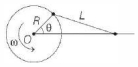
One end of a rod of length $L$ is fixed to a point on the circumference of a wheel of radius $R$. The other end is sliding freely along a straight channel passing through the centre of the wheel as shown in the figure below. The wheel is rotating with a constant angular velocity $\omega$ about $O$. Taking $T=\frac{2 \pi}{\omega}$, the motion of the rod is
A horizontal force of $40\,N$ is applied to a $5\, kg$ block which is at rest on the horizontal surface. If the coefficient of kinetic friction is $0.4$, then the acceleration of the block is ........ $m/s^2$ $(g = 10 \,m/s^2)$
The force of interaction between two atoms is given by $F\, = \,\alpha \beta \,\exp \,\left( { - \frac{{{x^2}}}{{\alpha kt}}} \right);$ where $x$ is the distance, $k$ is the Boltzmann constant and $T$ is temperature and $\alpha $ and $\beta $ are two constants. The dimension of $\beta $ is
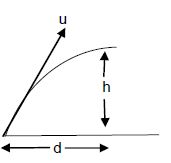
If a stone is to hit at a point which is at a distance $d$ away and at a height $h$ above the point from where the stone starts, then what is the value of initial speed $u$ if the stone is launched at an angle $\theta $ ?
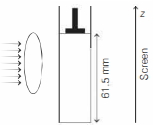
A parallel beam of light is incident on a tank filled with water up to a height of $61.5 \,mm$ as shown in the figure below. Ultrasonic waves of frequency $0.5 \,MHz$ are sent along the length of the water column using a transducer placed at the top and they form longitudinal standing waves in the water. Which of the schematic plots below best describes the intensity distribution of the light as seen on the screen? (Take, the speed of sound in water to be $1500 \,m / s$ )