MCQ
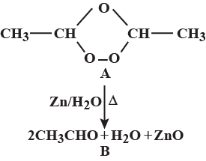
$C{H_3} - CH = CH - C{H_3}\xrightarrow[{(ii){H_2}O,Zn}]{{(i){O_3}}}{\text{Product}}$
- A$CH_3-CH_2-CHO$
- ✓$CH_3-CHO$
- C$CH_3-COOH$
- D$\begin{array}{*{20}{c}}
{C{H_3} - C = O} \\
{\,\,\,\,|} \\
{\,\,\,\,\,\,\,\,\,C{H_3}}
\end{array}$
Generate a complete, print-ready paper with questions like this in minutes — across 16+ boards, with answer keys.
$(A)$ $n =3,1=0, m =0$
$(B)$ $n =4, l =0, m =0$
$(C)$ $n =3, l =1, m =0$
$(D)$ $n =3, l =2, m =1$
The correct option for the order is :

$(I)\, [Co(NO_2)_3(NH_3)_3]$
$(II)$ cis $-[ RhCl_2 (NH_3)_4]^+$
$(III)\, [Cr(OX)_3]^{-3}$
$(IV)$ cis $ -[PtCl_2 (en)]$
$(V)$ trans $-[Cr(en)_2 Br_2]^+$
$(VI)$ cis $-[Cr(en)_2 Br_2]^+$
|
LIST $-I$ (Cell) |
LIST $-II$ (Use/Property/Reaction) |
|
$A$ Leclanche cell |
$I$ Converts energy of combustion into electrical energy |
| $B$ Ni-Cd cell | $II$ Does not involve any ion in solution and is used in hearing aids |
| $C$ Fuel cell | $III$ Rechargeable |
|
$D$ Mercury cell |
$IV$ Reaction at anode $\mathrm{Zn} \rightarrow \mathrm{Zn}^{2+}+2 \mathrm{e}^{-}$ |
Choose the correct answer from the options given below: